

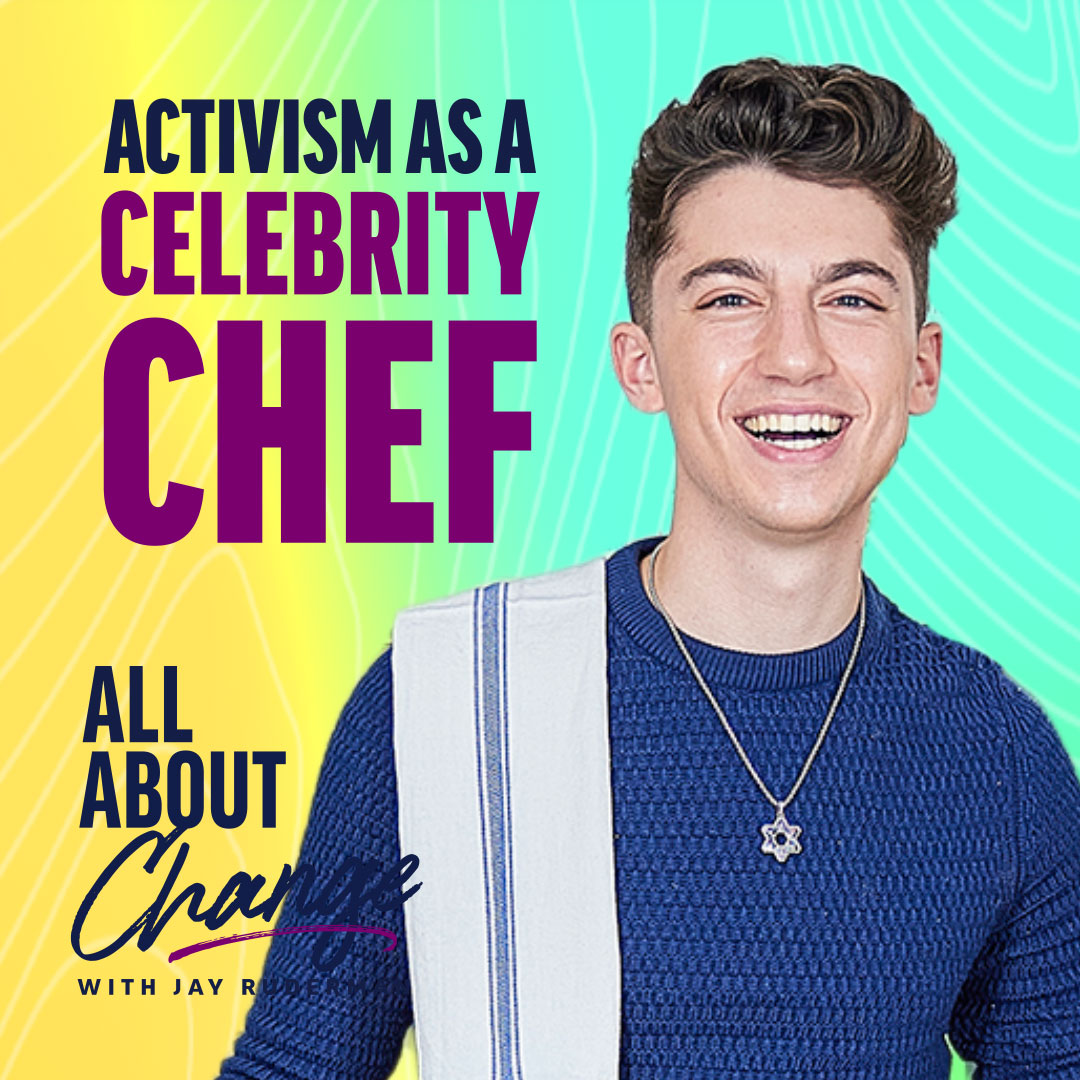
Few things bring me joy and hope quite like young people who are already involved in making the world a better place. Today, I have the pleasure of speaking with celebrity chef Eitan Bernath. The youngest individual ever to be named to the Forbes 30 Under 30 list in Food and Drink, Eitan found success cooking on Tik Tok, and quickly moved to TV, where he has served as the Principal Culinary Contributor on the Drew Barrymore Show on CBS since 2020.
AboutEitan is barely of drinking age and he is already involved in a wide range of activist causes. He is involved in local animal rescue and food rescue in New York City, where he lives, Jewish representation, and he serves as a High Level Supporter of the United Nations World Food Programme.
Eitan wasted no time parlaying his success into a platform for activism, and I’m so excited to share his story with you. We talk about his work in food rescue, models for ending food insecurity, and the way he has leveraged his large platform as a social media star as part of his activism.
Jay Ruderman:
Welcome to All About Change.
Hey, All About Change listeners. It’s Jay here, and I wanted to tell you my book, Find Your Fight, is now available in 800 Walmart stores. In the book, I talk about my biggest successes and those of others, and also failures as an activist and my personal philosophy on how to make a difference. It’s the perfect gift for friends and family who care about making a positive change in our society.
Few things bring me joy and hope quite like young people who are already involved in making the world a better place. Today, I have the pleasure of speaking with celebrity chef, Eitan Bernath, the youngest individual ever to be named to the Forbes 30 Under 30 list in food and drink. Eitan found success cooking on TikTok and quickly moved to TV, where he served as the principal culinary contributor on the Drew Barrymore Show on CBS since 2020.
Eitan is barely of drinking age and he’s already involved in a wide range of activist causes. He’s involved in local animal rescue and food rescue in New York City, Jewish representation and serves as a high level supporter of the United Nations World Food Program. Eitan wasted no time parlaying his success into a platform for activism. And I’m so excited to hear about his story. Eitan Bernath, thank you so much for being my guest on All About Change. I really look forward to this discussion.
Eitan Bernath:
Thank you for having me.
Jay Ruderman:
So Eitan, over the past five years, you’ve managed to get involved with so many wonderful causes and as an activist with a wide appetite for helping, how do you decide which causes you want to support and how do you get involved in them?
Eitan Bernath:
Yeah, so I have been working in food media now for 12 years, which is pretty crazy considering I’m 23 because that’s more of my life than I haven’t been. And so I’ve been surrounded by food so much in my life, both in a personal capacity, but also professionally. And so for me, it was a no-brainer in wanting to use my platform to support food insecurity efforts to combat food insecurity. And whether it’s from just, it’s something that interests me, something I genuinely care about, and also it’s something that is adjacent to what my audience is already interested in. So it’s very easy to incorporate that into content and to get people interested in paying attention.
Jay Ruderman:
So I’ve watched many of your videos and you create wonderfully delicious and beautiful food that’s photographed so well, and you are just very creative. How did you learn about the fact… I mean, you live in New York City, there’s an abundance in New York City, but there’s also people who they don’t have enough to eat. And how did you find out about that problem? And then what led you from finding out about it to taking action?
Eitan Bernath:
Yeah. So I mean, when you walk around New York City, whether or not most people realize, one in four children do not have stable food at home. It’s a staggering number. And after the pandemic and with inflation, it has only worsened. And so I work with an incredible organization here in the city called City Harvest, which is the city’s first and largest food distribution organization. Essentially what they do is they find excess food that’s super high quality, just like you or I would be happy and excited to eat, from farmers, from grocery stores, from food suppliers, from supermarket chains, from everywhere, and are able to bring it into their facility and then get it distributed to soup kitchen, food pantries and alike here in New York City. And their work really, really inspires me. And I’ve been one of the chefs on their food council now for definitely over four years, maybe close to five. And I try to be as involved as possible.
Jay Ruderman:
So let’s talk about Western society. And I just got back from three weeks in Japan and there’s an obsession with fresh food in Japan, and everything tastes wonderful and it’s prepared fresh. But I was thinking to myself, how much of this goes to waste? And I think it’s the same thing in the United States and New York. I mean, what is happening? Does most of that food that’s not being collected and redistributed, how much food goes to waste in our society?
Eitan Bernath:
Yeah. I mean, it’s crazy. The problem of hunger here in the US is entirely a decision on our government and both in the public sector and frankly, also the private sector. We have more than enough food. A staggering amount of food goes to waste, and much of it is food that is perfectly still good to eat. Just actually this past weekend, I volunteered separate from the media stuff that I do with City Harvest. I try to actually use my hands and volunteer whenever I can. And so I was at a food distribution center in Staten Island. We distributed almost 10,000 pounds of fresh produce to New Yorkers in need. And this produce we’re distributing is excess produce. Maybe they’re apples that were a little too small to sell in grocery stores that are less desirable. We had green peppers that frankly just must have been in excess because they looked fantastic.
We distributed pears, we distributed potatoes, and this is all perfectly great produce that luckily thanks to City Harvest, has been rescued and has then been distributed. There’s so much more. We have the food. It’s not like the US doesn’t have enough food to feed everyone.
Jay Ruderman:
So you’d almost think that… I mean, I know there are organizations and you talked about them that get involved in doing this, but you’d almost think that our government as responsible for its people would get more involved in addressing this problem and addressing hunger in a way that’s more systematic.
Eitan Bernath:
Yeah. I mean, it’s like the amount of the food that’s wasted is by many estimates as much as 30%, and that’s from the government. That is a ridiculous percent of our food that’s wasted. And now, of course, that accounts for many things. If you at home, let’s say, cook yourself dinner and there’s some food left in the pan or you’re cutting onions and then you throw out the peels, that’s part of food waste. And we could all do our own things to limit the food that we waste, but on a much larger industrial scale, there is so much food. And this isn’t only a problem in the US. There’s many countries on earth, India being one of them that produces incredible amounts of food, but still has a huge percent of the population who suffer from hunger. This is an issue that happens across the world.
And so it’s really up to, I think, governments and ideally NGOs and the private sector as well to step up and really find homes and mouths for this food because it’s there. It’s not like we need to figure out how to grow more food. We don’t.
Jay Ruderman:
I’m thinking of an interesting clip that you just posted a while back about your trip to India and how there was a Sikh organization that had a kitchen in the religious center and they were producing food so that anyone who wanted to eat could come in there and eat, which was such an amazing moving thing because you don’t think about that of people just welcoming anyone into their facility and saying, “Hey, there’s extra food here. Come eat.” What was that experience like for you?
Eitan Bernath:
Yeah, it was incredible. So I was in a Sikh gurdwara, and gurdwara is the word they used to call their house of worship. And there’s an incredible part of their tradition called Lengar, I might be mispronouncing it, I think that’s how it’s pronounced, where people donate, farmers donate produce and the food is donated, and then people also donate their time to come cook the food, and then anyone who needs food can come in and eat the food. And I think what was so incredible about it is it truly is anyone. You don’t need to be a Sikh, you don’t need to be someone who’s coming there to worship. Just if you’re hungry, literally every single day you could go there. And it’s all about everyone being treated equally. You all sit on the floor, you’re given the banana leaf and the food’s put in front of you. There’s no hierarchy.
There’s someone who’s worshiping there is treated any differently than any person that walks in. And this is something that’s not just done in India, this is done from, as far as I know, across the world in Sikh gurdwara. And it just was such a striking, beautiful tradition… Not even tradition, but something that’s actively done that they really… It’s one thing to say, I believe we need to do our part to feed the hungry, but this actual every single day in and out execution of that is really impressive and really beautiful.
Jay Ruderman:
There is something beautiful about that because instead of in our country, we’re like, okay, well, if you want to eat, there’s a soup kitchen and you can go and there’s food there in some cases, but this is actively going out and saying, “You’re welcome into our house of worship. We’re actively going out and providing food for you.” Do you think something like that could work here in the United States?
Eitan Bernath:
I think on a national scale… I mean, I do know there are in the US, because especially a lot of members of the Sikh community in the US had responded and messaged me when I had posted that. In the US, there definitely are gurdwara that do that. And maybe so if the Sikh community opens one up everywhere, that’d be amazing. But I think in a practical sense, I think it really can show the power of volunteer work and because it’s not just a financial thing, people show up and what the person who was giving us a tour of the place really spoke about is a lot of the people volunteering. There were women and men everywhere cutting vegetables. Me and my family joined them in one of the rooms where you’re rolling out roti, the flatbread. Many of the people who are volunteering there also come there to eat regularly and need to do so.
And so I think what can be learned from that and scaled more is more encouragement of actively doing your volunteering. It’s like my grandma, my grandma Bobby, throughout my life when she was able to more physically would volunteer when she lived in Austin in Westchester, would volunteer at soup kitchens and food pantries. And for her, it was maybe checking people in or whatever kind of things they needed. And it’s something that really inspired me. I do a lot with City Harvest. I also work with the World Food Program on a more international scale. I do a lot in media, whether it’s going on television to talk about them, posting on my social media, but something that’s really important for me, and I try to do as much as I can, is actually physically using my own two hands to help like I did this weekend. And I think that’s something that we could really encourage across the board more.
Jay Ruderman:
You reminded me of my bubby and how she did not drive, but she loved cook, and she would cook meals for her friends who were maybe less fortunate than her and she would take those meals, put them in a paper bag and walk them to their homes to make sure that they had a nice meal for lunch or for dinner or something like that. And what role does fun play? Because when I see you in a video, first of all, you have a magnetic personality and people are drawn to you, I mean, not just for your delicious food and your creativity, but also you have a smile on, you’re laughing, you’re having fun. Talk about the importance of that because I think a lot of us maybe discount that and say, “Oh, this is work and this is tough.” And it seems like people aren’t having enough fun going through life.
Eitan Bernath:
I definitely am a big fun person, I would say or hope to say. I think for me at the end of the day, my goal with the videos I produce is to get people excited to cook. And at the end of the day, my job is a job. There are days where I am not in the mood to film a cooking video, but I need to. And maybe I’m a little less excited in my heart than my face is projecting, which is not frequently, but I’m a human and at the end of the day, me posting videos is my business, but I think there’s a balance, especially working in the field that is my passion of, it’s my passion, but and at the same time as a business. And so I’m really in a unique situation where I get to really have this creative control and have a lot of fun with what I’m doing, even talking about food insecurity.
I think something that I really make an effort is I’m not going to be posting videos guilting, “Oh, this many people are hungry. You should donate money, blah, blah, blah,” in a sad way. I try to approach things even from that sense from this problem exists and here’s what we can do about it. And whether it’s just showing me volunteering or highlighting City Harvest’s work, I think that for me, I know how I speak with my audience and the relationship I have with them. And so even when I’m speaking about philanthropic work or volunteering work, obviously if you need to stand outside in Staten Island and hand 500 New Yorkers produce for free that they can’t afford, that’s a tragic, upsetting thing, but that doesn’t mean that’s how you need to present it. You could talk about it as…
And because here’s the thing, I had a good time doing it. People had great attitudes. The people I was volunteering with, we had fun just kind of schmoozing while doing so, wishing everyone who came in, “Oh, good morning. How are you?” There were some adults brought their children with them, saying hi to the kids. It’s of course a upsetting thing that this need is out there, but being active and doing it doesn’t need to be upsetting. I was not upset at any time when I was volunteering. I was having a nice time. It was fun to get to meet 500 people, ask them how their day is, smile, they smile back. And I think that’s what I try to highlight.
Jay Ruderman:
And I think you truly love the human interaction, which is really important.
Eitan Bernath:
Yes. I would say I’m a big extrovert.
Jay Ruderman:
Do you ever find yourself as a mentor in talking to other influencers and trying to encourage them to give back more?
Eitan Bernath:
There’s a lot of great opportunities to support organizations and causes that are important to you in your heart through your work that also can end up being quite reciprocal. And I think that’s something I always try to tell a lot of friends of mine who do this is through my work with City Harvest, the reason I’m passionate about City Harvest or the World Food Program or any of these organizations I support is because it’s something I care about and I believe in their work. And there’s many incredible organizations and City Harvest is one of them, when they partner with media figures, also have really cool opportunities they could bring you. I’ll give you an example. I think this was about two years ago in honor of an event that City Harvest was doing, I got to light up the Empire State Building that night, which was super cool. It was an incredible media moment.
Whether it’s been that or I’ve gone to meet incredible other chefs that work with City Harvest, I have materially from a brand sense have benefited immensely from my partnership with City Harvest. It’s not the base reason why I work with them and support the work at all, but something I tell people a lot is a lot of organizations are eager for your support. And if you find one that really resonates with you and you’re passionate about, oftentimes if what they’re doing is really cool, they have cool opportunities to bring you as well. And so it’s really a 360 type of relationship. And it’s something that I try to tell people, is everyone has limited bandwidths. You can only do so much in a day, but the reality is if you’re passionate about it, a lot of times beyond doing what feels right and what you know is right, it actually can also benefit you in a cool way.
Jay Ruderman:
You’ve been in the spotlight since I think age 11, before your bar mitzvah.
Eitan Bernath:
Yes. Yes.
Jay Ruderman:
And I loved you on Chopped and your 11-year-old Eitan with the kippah. And I’m just wondering how much has your Jewish identity changed as you’ve gotten older and moved along your journey and how has your Jewish identity shaped your journey?
Eitan Bernath:
Yeah. I mean, so when I competed on Chopped when I was 11 and started an Instagram page and started creating content online, I would say probably 90%, if not more, of who was supporting me and excited about me was the Jewish community. I grew up in Teaneck, New Jersey and in a very strong supportive Jewish community. The first media pieces written about me were in the local Jewish papers. Nowadays, 12 years later, the overall majority of my following, I would guess probably 95%, if not 99% of my audience, just like because of the population of the world, is not Jewish. I still have a super strong, very loud, very supportive Jewish following. And yeah, I think I absolutely have the Jewish community to thank for A, the beginning of my career and being so supportive and just continuing to be super supportive.
And I think in terms of being on the internet as a Jew, that definitely comes with its set of challenges, have absolutely faced immense antisemitism, awful death threats, very, very unsavory messages. It’s something that at this point I’m quite used to, but I’ve volunteered with different Jewish organizations and have spoken up about combating antisemitism. And it’s a very integral part of who I am. The food I cook is not generally Jewish food. My account’s not about being Jewish, but it comes up all the time because being Jewish is a ginormous part of my life.
Jay Ruderman:
And you don’t hide from it.
Eitan Bernath:
No, not at all. Even despite obviously the last years or so as a Jew on the internet has been exceptionally challenging. And I think for me, just staying strong to my beliefs and my pride as a Jew. And it’s definitely, there were some times in the last two years where there were some super, not very specific death threats. There were times I’ve been, unfortunately, had to be in touch with the FBI about specific things, which is not fun, but it’s part of the job. An unfortunate part, I guess.
Jay Ruderman:
But I also say, that you have a very mature view. Some people would have a very difficult time dealing with what you have to deal with online, and you seem to have developed a very thick skin, or at least a way of dealing with it.
Eitan Bernath:
I think I’ve kind of always had a thick skin. I know when I was on Chopped when I was in middle school, I got made… Well, first off, at 11 years old, I got Chopped in the appetizer round on national television with my whole school and everyone I knew watching. So I think that definitely got me started with having a thick skin and being able to take some punches. But I think beyond that, I definitely got made fun of when I was younger for cooking. Now people think it’s cool. It definitely was not cool when I was nine, 10, 11, and I think that’s definitely how it started.
And beyond that, I think just being in the public eye, whether it was when I was younger and had acne and getting comments, “Oh, you have pimples, blah, blah, blah.” Or I even had braces when I was on Chopped and was starting, out about a year on the internet or even less will probably build you with thick skin. If someone on the internet has the thought about you, they’ll let you know. And so I think I’ve just gotten quite used to it and I think it’s helped me become a super confident person. And I was actually just talking to someone about this the other day about how it’s funny when you’ve done this for so long, you have a very thick skin and then randomly, once in a while, someone will send you a hate message about some very specific thing you didn’t even know you’re insecure about, and then it hits you like, “Oh my God, are they right?”
But I would say in general, specifically with antisemitism, I mean, obviously someone telling me, “I hope all Jews die.” It doesn’t upset me. It’s upsetting that people feel that way, but nothing I did to deserve that other than be born into the religion and heritage I was born and choosing to be proud of it. And beyond that, I think antisemitism has so many forms, whether it’s… I sometimes get messages that Jews aren’t the real Jews, and that whether it’s a Black Hebrew Israelite telling you that Jews are not actual Jews and they’re the actual Jews and that we’re imposters, or whether it’s people, antisemitism or blaming Jews for the actions of the Israeli government, there’s so many forms of it and it’s unfortunately saying that there’s new forms being figured out and invented, it feels like every day.
Jay Ruderman:
Well, I think that being famous is not always easy and it’s not always natural. So I’m wondering how important a role does your family and your close network of friends play in giving you that stability that allows you to do something that puts you in a very vulnerable situation?
Eitan Bernath:
Yeah. I mean, I think a lot of times when people, sometimes find me kids or teens and they’re like, “Oh, when I grew up, I want to be a social media influencer. I want to be famous.” I think something that I’ve learned as basically spending now more of my life than not in the public eye is it is absolutely not for everyone. I think I have a pretty perfect set of self-confidence and thick skin that it works for me, but there are many, many, many, many, many, many, many, many, many challenges with it and things that I think most people would strongly dislike, and frankly, many parts of it that I dislike. I think for me in my life, the pros of my job severely outweigh the cons. But whether it’s just opening yourself up to everyone’s opinions, and not only that, is I can post something and off someone who then knows my parents and could say something to them about it.
And so things that I do in my actions don’t only affect me, they affect people that are maybe close friends of mine or family members. And so for me, it makes me really value. I’m super close with my family. I live here in Manhattan, my family’s in Jersey. I see them at least once or twice a week. I talk to my mom and dad every single day and my brother Yoni as well. And so it’s super important for me, whether it’s my family, my friends, it’s important to keep a good close-knit inner circle and just have people to talk to, because there’s definitely very unique challenges that come with this job that can be hard to talk about or hard to relate to with normal people who… Not normal people, sorry, people who don’t experience having millions of strangers on the internet tell you what they think about you every day.
Jay Ruderman:
Hey, Eitan, I want to talk in my book, one of the biggest steps that I talk about as an activist that you can make is to find your fight, to really find what’s important to you and to go after it. And I feel like you’re just getting started. So I’m wondering, what sort of impact would you like to have in the next five to 10 years? How do you envision yourself as an activist and how does that work itself into your career?
Eitan Bernath:
I think in the food insecurity space, something that I’ve enjoyed doing that I would love to do more is be able to do more storytelling of unique solutions that are put in place throughout the world, kind of like what I did in that content series that you referred to in India. I’d also highlighted some incredible initiatives in this northern state in India called Behar, where they’re helping women farmers optimize. One of them was out raising goats, another was more focused on agriculture. And so I think being able to highlight those solutions and raise awareness on them or sign that, I frankly really enjoyed the process of and hope to do more of. And then beyond that, just continuing to find ways to creatively incorporate the messaging into content in kind of fun and engaging ways, increasingly with the algorithmic content distribution on all the platforms, just posting a video of me talking straight to camera plainly about food insecurity is going to get 100 views.
And so you really have to be creative and make content entertaining, even if it’s about something like that. And I hope to continue doing that and continue to encourage people to get out there and donate and donate their time, frankly. I think there’s a lot of organizations that have a lot of money. Donating money’s great, but I think a lot of times people may say, “Oh, I don’t have the money to donate. There’s nothing I can do.” If you have a free Sunday morning, you could go to your local soup kitchen, your local food pantry. And I think that’s something I like to encourage people to do is because truly, whether it’s me handing out food, Grandma Bobby, checking people in while sitting in a chair, I think that’s a good example of how we really all can do our part no matter how small it feels. And I think that that’s something I really want to continue to encourage people and find creative ways to do that.
Jay Ruderman:
It’s such good advice because I get approached by a lot of people and they say, “I want to get involved as an activist. I don’t know what to do. I don’t know how to start.” And I once interviewed not too long ago, Jonah Platt, and his advice was, “Just do it. Just go out and do it. Just start doing something and it’ll lead to something.” Eitan, I want to leave you with a compliment because I know you travel all over the world, you’re all over the place and you’re busy and you meet people and you learn so much, but the way you do it is so respectful of other people and that’s rare. I don’t see that all the time. I see things as being very transactional, but I don’t feel that your interactions are transactional at all. I think that you’re really treating people with respect. You want to learn and you want to do it in the right way. So thank you for doing that.
And I really appreciate what you’ve done both as a young person and really having a fabulous career, but also giving back to our society and really having an impact. So Eitan Bernath, thank you so much for being my guest on All About Change. I’ve really enjoyed this conversation and I wish that you will go from strength to strength.
Eitan Bernath:
Thank you. Thank you. That was very kind of you and thank you for having me. This was a lot of fun.
Jay Ruderman:
Thank you for being part of the All About Change community. We aim to spark ideas for personal activism, helping you find your pathway to action beyond awareness. So thank you for investing your time with us, learning and thinking about how just one person can make the choice to build a community and improve our world. I believe in the power of informed people like you to drive real change, and I know that what we explore today will be a tool for you in that effort. All right, I’ll see you in two weeks for our next conversation, but just one small ask, please hit subscribe and leave us a comment below. It lets us know that you value this content and it supports our mission to widely share these perspectives. If you’re looking for more inspiration, check out this next video. I chose it for you and I know you’re going to enjoy it.
I’m Jay Ruderman. Let’s continue working towards meaningful change together.
Today’s episode was produced by Tani Levitt and Mijon Zulu. To check out more episodes or to learn more about the show, you can visit our website Allaboutchangepodcast.com. If you like our show, spread the word, tell a friend or family member, or leave us a review on your favorite podcasting app. We really appreciate it. All About Change is produced by the Ruderman Family Foundation.