

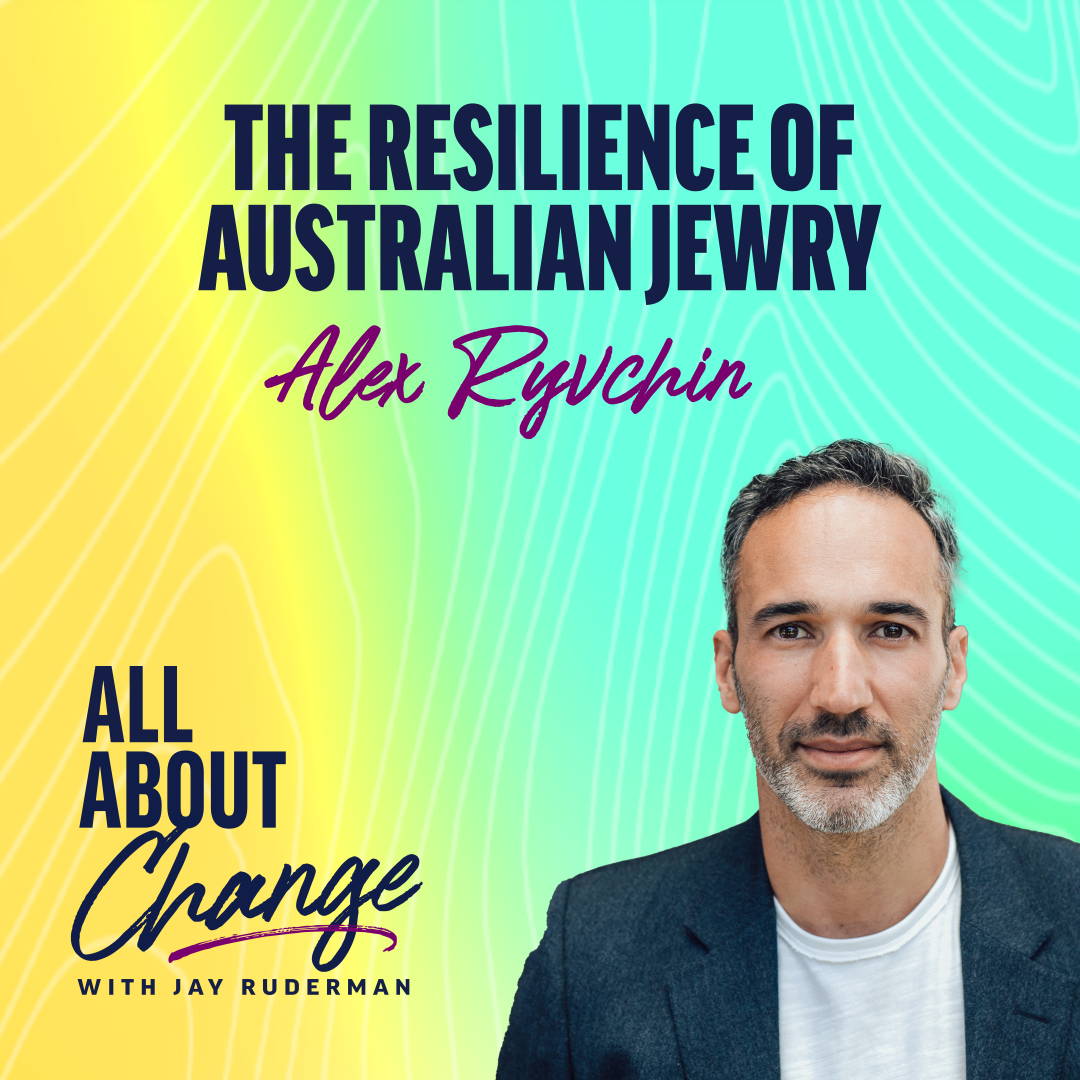
Alex Ryvchin is co-Chief Executive Officer of the Executive Council of Australian Jewry, the author of internationally acclaimed books of history and politics, and a best-selling children’s author.
AboutOver the past twelve years he has been a fierce advocate for the Australian Jewish community and Israel.
His advocacy and writing has seen him recognised as Australian of the Year for 2024 by The Australian newspaper, as one of 25 global Jewish visionaries by The Jerusalem Post and ranked 38th in the Daily Telegraph’s Power 100 for 2024. He is the recipient of the 2025 B’nai B’rith Human Rights Award, and I’m so excited to have him on the show today.
Jay Ruderman:
Welcome to All About Change. Now is a great time to check out my new book about activism, Find Your Fight. You can find Find Your Fight wherever you buy books, and you can learn more about it at jayruderman.com. My guest today is Alex Ryvchin. Alex is co-chief executive officer of the Executive Council of Australian Jewry, the author of internationally acclaimed books on history and politics and a bestselling children’s author.
Over the past 12 years, he’s been a fierce advocate for the Australian Jewish community in Israel. His advocacy in writing has seen him recognized as Australian of the Year for 2024 by the Australian newspaper as one of 25 global Jewish visionaries by the Jerusalem Post and ranked 38th in the Daily Telegraph’s Power 100 for 2024. He’s the recipient of the 2025 B’nai B’rith Human Rights Award, and I’m so excited to have him on the show today. Alex Ryvchin, welcome to All About Change, and thank you for being my guest.
Alex Ryvchin:
Thank you so much, Jay.
Jay Ruderman:
So, Alex, let’s start talking about the Jewish community in Australia. For most of our listeners who are probably in America, what are the needs of the Australian Jewish community, and how could they be different from those Jewish communities in America or in England?
Alex Ryvchin:
Look, I think the last two years have been a great equalizer for Jewish communities throughout the world. And to be honest, our needs were probably minimal before October 7, and now they’re much like the rest of the world. And in many regards, I would say, “They’re more urgent and more serious.” I would say, “That we have had the sharpest decline of physical security of any Jewish community anywhere in the world.” And in my role, I engage frequently with Jewish community leaders from all over the world, from Europe and the Americas, very small communities in Asia, and everyone is baffled by what has occurred in Australia in the last two years.
We’ve had this surge in vulgar street antisemitism of Jewish school kids being abused and harassed. We’ve had organized boycotts, particularly against Jewish creatives and artists. It’s been a really challenging time for the last couple of years. And in terms of what we need, we need a more productive, a more forceful response from the federal government, predominantly. That hasn’t been there. But also we need all Australians to realize that when one community, when one group of the Australian society is targeted, when their rights to freely walk down the street and display their identity, their rights to worship in their temples, when these are attacked, it’s an attack on Australian values and democracy.
So I think that’s something that the wider public hasn’t fully grasped, the fact that this isn’t our battle alone. It’s really a national issue. Just in the last couple of days, there was a demonstration outside my state’s parliament of neo-Nazis, proper neo-Nazi thugs, chanting, “Blood and honor”, the Hitler youth slogan. Holding up a huge banner saying, “Abolish the Jewish lobby.” Now, this was condemned from left to right, from all political actors, all quarters of society. There’s no one supporting these people. But for the last two years, we’ve had particularly those on the far left inciting against the Jewish lobby, accusing the Jewish community when we speak for ourselves and try to assert our rights as Australians of controlling the media and controlling government.
The same notion is about this insidious Jewish lobby. So when it comes in the framework of a conversation about Israel, it’s legitimized or it’s placed in the two hard baskets. So I think that’s really the major problem. The source of the antisemitism determines what the response is, when that shouldn’t be the case. The response should be determined objectively by the act and by the victim of that act. But too often, when there’s an out for political reasons, people are willing to take it.
Jay Ruderman:
It’s my understanding that there is a large percentage of Holocaust survivors in Australia. And I’m wondering if you know from your personal experience interacting with them, how this is hitting them, having escaped the Holocaust, moved almost as far away as you can move, and then being faced with this upsurge in antisemitism.
Alex Ryvchin:
It’s hit them really hard, Jay, really hard. And in the early months since October 7, after October 7, when even in the immediate aftermath, in the couple of days after October 7, there was this deplorable scene, which was then beamed throughout the world of a group of thugs masked, gathering outside the Sydney Opera House, which is our most iconic landmark and chanting, “Where’s the Jews,” and, “F the Jews,” and burning Israeli and Australian flags.
And at that time, I was having survivors of the Holocaust and their children saying things to me like, firstly that they never imagined this could happen in Australia because like you said, they fled to what they thought was the most peaceful Western country in the world and the one that’s furthest away from the horrors of Europe. And I had children and grandchildren of survivors saying to me, “I’m in some way glad that my survivor descendants aren’t alive to witness this, to see what our country has become.” It’s really been shocking.
And these are people who know antisemitism better than anyone, who have that deep experience, who have that trauma, who see that process of dehumanization, of demonization, who see the resurgence of the same conspiracy theories, the blood libels, the accusations of domination. It’s all back. And for a country like Australia with no record of institutional antisemitism, a place where the Jews have lived since literally the very first day of European settlement, Jews have been here.
There were about 14 Jews on the first fleet of convict ships that came in the late 18th century. So our roots here are as deep as any non-indigenous peoples. We’ve contributed to every aspect of Australian life immensely, whether it be the military or culture, politics, the sciences. And now to see this organized campaign to intimidate us, to push us out, it’s been really confronting and really shocking.
Jay Ruderman:
For those listeners who are not as well aware of what’s gone on in Australia, maybe you can talk about some of the physical attacks. And I know that, for example, your former home was attacked. Maybe you can just talk about the intensity of the attacks in Australia against the Jewish community.
Alex Ryvchin:
Yeah. Well, look, as I mentioned, it really began even as October 7 was still unfolding and those horrific pictures were coming in, and we were in our grief and mourning and shock, still processing and coming to terms with the full scale of the horrors. And you had in cities around Australia, including in my home city of Sydney, half an hour from where I’m sitting now speaking with you, there were Islamic clerics on the street, inciting mobs, calling this a day of joy and a day of pride, expressing elation at what had been done to our people.
And a couple of days later on October the 9th, there was a gathering, as I said, at the steps of the Opera House, which is really the most important and iconic of all our landmarks, where this violent mob was chanting medieval battle cries to kill the Jews and so forth and burning flags and really menacing the community. And that set a tone.
And then in the months that followed, it was a daily barrage, whether it be individuals walking down busy beaches in Sydney and abusing Jews and threatening to rape Jewish women. Jewish schools were being denied service. One school wanted to hire a jumping castle for a school event and the proprietor of the business that they approached refused to hire to them because they were Jewish. These things were becoming absolutely routine on a daily basis, physical intimidation, harassment, and it was getting worse and worse and worse.
And we know in our bones through Jewish history where these things go. We know when you deal with fanatics, they don’t stop. They go as far as they’re allowed to go. And we were crying out for action because we knew that this would end with violence. And sure enough, a spade of firebombings began in December last year with the virtual complete destruction of a synagogue, which was built by Holocaust survivors in Melbourne. The Adass Israel synagogue was scorched virtually to the ground, which was just a horrific thing for the community.
And you mentioned before, the large number of survivors in our community for them to have to witness a burning synagogue. And then following that in the days and weeks afterwards, there were fire bombings of vehicles in Jewish neighborhoods with slogans like F the Jews and F Israel adorbed on them. There was an attack on another synagogue, an attempt to burn another synagogue. And then there was the attack on my former home, and police have since revealed that they believe that my family still lived in that house and that I was deliberately targeted.
They sprayed red paint on the facade of the house and burned three cars that were in front of the house, and again dorbed F Israel and F the Jews on the vehicles. You then had a couple of days later a childcare center being burned. So these things are so foreign to our community in Australia, but also to the country.
You don’t have racially motivated attacks of this sort against anybody. And this was becoming staggeringly, alarmingly routine, a daily basis. I would wake up every morning just waiting to see what was hit, what the target was. And it was a horrific way to live, and people became very apprehensive about their physical security. But I feel like the Jewish community has been tested immensely, but has come through that test. It shows our pride in being Jewish, our pride in being Zionist and our determination to remain Australians. That’s a core part of who we are, and we love this country.
Jay Ruderman:
Who have been the greatest allies of the Australian Jewish community, and how have you been able to work with them together to support your community?
Alex Ryvchin:
Look, I would say, “The greatest allies have been, particularly in the media, the more kind of conservative leaning media.” So the daily newspapers, the Australian, and the Daily Telegraph have been incredibly supportive of the Jewish community, have elevated our voices and our concerns, not just us here domestically, but also the hostages, their plight, what Israel’s been going through. They’ve been unbelievably good and unbelievably supportive. Sky News, which is very different to Sky News in the United Kingdom has been exemplary as well.
But beyond that, there hasn’t been a great amount of organized support. So a lot of the people that we thought would be there, a lot of the interfaith relationships that we’d invested in over many years because we believed in that sort of work probably hasn’t been there. The support has been tepid and sometimes non-existent entirely. Again, I think it comes down to what we discussed at the outset about this kind of political taint that anything to do with the Jews seems to have.
It’s too controversial, best to leave it alone. So there hasn’t been like this mass kind of solidarity campaign with the Jewish community, as I believe there would be with virtually any other community facing anything approximating what we’ve gone through. But I think that the greatest support has come from what I would call everyday Australians. And I hear from them, they write to me literally every single day. I get stopped in the street in little country towns, in the regions, in cities, in restaurants by ordinary Australians who say, “We support you. We’re with you. We aphore what’s been done to the Jewish community.” I think the fair-minded Australian looks at the fact that we are proud and patriotic Australians. We have contributed disproportionately to the greatness and the wealth and the success of this country. We’re a peaceful community, we’re law-abiding, and they support that, and they don’t like what’s being done to us.
Australians, I think, are marked by fair-mindedness. I think that’s a defining quality of being an Australian, a sense of fairness. And they know what’s being done to us is horribly unfair. And to feel that support every day, it’s meant an enormous amount, it truly has.
Jay Ruderman:
Do you think that people are aware that when there’s intense Jew hatred, it doesn’t end with the Jews. It may start with the Jews, but it just infects the entire society and other groups are also singled out and attacked.
Alex Ryvchin:
I’m not sure they do, to be honest. I mean, you and I know this so well, Jay. It runs through our history. We know that a society that submits to anti-Semitic conspiracy theories is not a healthy, not a rational society. Society that blames the Jews for all its ills is not going to be doing well. It’s not going to be embarking on scientific discoveries and entrepreneurship. It’s a society on the decline. And we know this, we know the process, we know the warning signs, but I feel like most Australians still view attacks on the Jews. They don’t like them, but they view it as being, again, something political, something linked to a foreign conflict, and they don’t realize that it’s a warning of something deeply, deeply wrong with a society, of some rot that is beginning to set in.
When people start to believe these things, it’s a sign that we need to really repair the course that we’re on. And when people start abusing school children on the streets because of what they identify them with or their national origin, it’s not going to end with the abuse of those children. The fact that that kind of level of bullying and disrespect and inhumanity is able to be expressed, often with impunity, of course that’s not going to remain with the Jews. It’ll be the next group that will be targeted afterwards. But I feel like people are inherently kind of selfish and until their direct interests are affected, I think they think this is someone else’s problem.
Jay Ruderman:
I was in Berlin not so long ago, and one of the major universities there had the greatest Jewish minds in history who were forced out of the country, and these universities have never recovered since then in terms of their greatness. And I’m wondering if people realize that if it gets very, very uncomfortable for the Jewish community, it’s not going to bode well for overall Australian society.
Alex Ryvchin:
It’s so ingrained in our story that understanding of the contribution of Jews to wider society. It’s a story that we tried to tell so much. The greatest general that ever served in Australia is Sir John Monash, who was a Jew and the founder of the Zionist Federation in this country. The first Australian-born governor general who is the Queen’s representative as head of state in Australia, Sir Isaac Isaacs was a Jew. The people that contributed so much to the arts and to the wealth, the business, scientific discoveries, so many of them are Jewish, but I feel like people don’t truly appreciate the Jewish contribution until it’s gone. So it’s difficult for them to make that connection between the oppression and persecution of the Jews, them potentially taking flight, and then some personal impact, which they might suffer down the line because of that lack of Jewish contribution and ingenuity. But there have been a couple of incidents which I feel really cut through. And there was an incident which I think made international news a few months ago where you had two nurses at a public hospital online-
Jay Ruderman:
Oh, yes, I remember this.
Alex Ryvchin:
And they engaged with an Israeli, and when they found out the person they were speaking to was Israeli, they started talking about how they’ve poisoned and murdered Jewish Israeli patients in the past and how they’re going to do it again. And it wasn’t even what they said as horrific as it was. It was that calm calculating tone, that madness which was presented in such a kind of offhand, almost rational way. And I think that really shook Australians because the healthcare system is sacred. We expect that whoever we are when we turn up for urgent medical care will be taken care of. And that showed people that actually maybe not all is well. Maybe this antisemitism has infected society to such an extent that it’s going to affect how everyone is treated.
So there’ve been several instances like that, which I think served as major wake up calls to the nation. But as I said, people stop me every day and say, “They’re seeing what’s happening to us specifically, and that’s enough for them.” The fact that one community is being targeted, to them that’s wholly un-Australian and unacceptable, and that’s really fantastic they feel that way.
Jay Ruderman:
So unfortunately, a lot of your work is debunking myths and combating misinformation, but I want to give you an opportunity to talk about the positive. What have you and your fellow Jewish leaders been able to achieve for the Jewish community in Australia, and what do you hope yet to achieve?
Alex Ryvchin:
I think the greatest thing that’s come from all this, there’ve been several positives. And firstly, the strength and the resilience and character that the Jewish community has shown. The fact that they’ve stood up to everything that I’ve cataloged in this discussion, they’ve come through it, they haven’t submitted, they haven’t withdrawn from society, they haven’t stopped wearing kippah, they haven’t stopped going to Hanukkah events, which we’ll have again in a few weeks and will have record attendance as I’m sure. They haven’t stopped walking to shul on the High Holidays or Shabbat or sending their kids to Jewish school.
So I think we’ve shown the character of the Jewish people, that strength, that resilience, that eternal nature. And a lot of people, I think, and this comes out in polling and research that we do from time to time, they don’t know who we are. They don’t know. They know that an Italian Australian comes from Italy, speaks a certain language, is associated with certain foods and pastimes. With Jews, they don’t know who we are. And so even though that the exposure and scrutiny and interest has come from some pretty nasty things, it’s given us an opportunity to tell our story, to show who we are, what we look like, what we believe, what we sound like. And I think shadows some stereotypes and myths. And I feel like it’s going to lead to a better long-term engagement between Jews and non-Jews in this country.
But in the short term, it’s pretty fraught. And I think some Jews do feel uncomfortable disclosing their identities. I think they’ve started to shelter more in Jewish institutions, Jewish law firms, art galleries, rather than seek being maligned or boycotted or pushed out or rejected in wider society. And I think that’s a real problem.
Jay Ruderman:
Right. I see that here also, that there are those who have a typical, what I would say, “Diaspora mentality,” where they want to fit in and fitting in is sort of like giving in. But yet also you find those who are standing up and proud of their heritage and saying, “Okay, this is the time to stand with my people.”
I want to ask you, Alex, about your career specifically. You’re a very prominent leader at a very young age. What is it like for you to walk into meetings and sit at tables when the people that you’re surrounded with may be significantly older than you?
Alex Ryvchin:
Look, it doesn’t phase me. The people in the Jewish communal leadership who came before me and many of whom are still active in Jewish communal life in this country, they are overwhelmingly devoted and wonderful people from whom I’ve learned so much. They’ve mentored me through the years, and they respect my opinions and my contribution and I respect theirs. And so I don’t feel intimidated by that. I don’t feel out of place in any way whatsoever. And I feel like I’m part of a story, of a continuum. When I look at the fact that in the ’70s and ’80s, my organization, the Executive Council of Australian Jewry, led a national campaign to understand the plight of Soviet Jewry and the persecution that Jewish families in the Soviet Union were facing the exclusion, the discrimination, the street abuse, much like what we’re facing here now.
They raised the campaign, it went to the national parliament, and then it was raised by Australia, the United Nations. It was the first country to raise that particular issue. And then of course, it became a huge global campaign culminating in families like mine, being able to leave that place and live in freedom in the West. So I’m very conscious of that history, and I know that I’m now a part of that history and I’m building on what was done. So we’re a very harmonious community. Our leadership is very unified and very motivated. And a time like this, any petty differences of country of origin or level of religious observance or age or gender, it’s kind of obliterated because we know that we’re fighting for something that is so fundamental and is so important to our future as Australians and as Jews that everything else gets shoved aside.
Jay Ruderman:
There’s the age-old debate, and you’re a very brave and strong leader. Do leaders respond to the times, or do the times make the leaders? And I’m wondering which category? Do you think that since October 7th, you have changed as a leader?
Alex Ryvchin:
That’s a really good question. I mean, I haven’t had time to really even pause and reflect on that. I guess the work that I’ve been doing the last two years, I’ve been doing for many years before that, writing books and representing the Jewish community in the media and in the political realm as well. All of that, giving speeches, Holocaust remembrance, all that sort of stuff that’s always been important to me. But since October 7, firstly, the volume of work, the stakes, the scrutiny, the number of people who now oppose us, it’s all sword and no doubt that has changed me. So in some ways, I’m exactly the same, and I’m doing what I was placed here to do, what I prepared to do for many years, developing the ideas that allowed me to step up on October 7 and to fight for the community, I hope in an effective way that has given strength to the Jewish community.
But also, when you go through a period like this of endless work for two years of such scrutiny and stakes, it’s surely got to change you in some way, but I feel like I’m still fundamentally the same person, surely. But I have fewer friends and more friends in some ways because a lot of my personal friendships, I haven’t been able to sustain, which kind of saddens me a little bit. I just haven’t had the time to do that. I have a wife and three kids and a community to look after, but then I’ve gained a lot of friends when I walk down the street, people who know me better than I know them, but I feel this immense kinship and love for them. So that’s meant a great deal to me. It’s really meant everything. It’s felt like an immense privilege to be able to do something for your people in a time like this. It’s been very beautiful.
Jay Ruderman:
I want to address something that you brought up, your family history of being Refusenik. How has that shaped you, and how has that come up in your work?
Alex Ryvchin:
I feel like it’s always been a huge part of who I am. And even though my personal experience of it is extremely limited, I was three years old when we left the Soviet Union, and it’s sometimes difficult to really fathom being born in Kiev and being from that place for generation after generation. But I was raised very much on the stories of my parents and grandparents. Stories of cruelty and injustice, stories of killing fields in every town and village, stories of having a dream shattered, of working in a certain profession or studying a certain university solely because you’re a Jew, of taking beatings in the school yard or the football field on a daily basis. I feel so grateful to my parents and my grandparents for not sheltering me from that.
They could have taken the view, we’re now in Australia, we’re thousands of miles away from that. What do we need to burden this kid with that for? But I’m so glad they did because they shaped my consciousness, my awareness of what it means to be a Jew, my pride in being Jewish and my determination to fight. And when you come to a country like this, that is free and fair and wonderful, and you have that historical awareness, you’re going to stand up and fight. And when you see the same repetition of events, the same slurs, the same snickering hatred, the same desire to humiliate us or drive us out of view, you’re going to recognize and you’re going to do something about it. So it’s really been the core component of who I am and my sense of self and sense of being a Jew.
Jay Ruderman:
We talked a lot about the dire state of affairs in Australia. What brings you hope at this time for the country and for the community?
Alex Ryvchin:
I’d say there’s two things. One is the community itself. And if we coward through this time, if we split apart and turned on each other, if we fled on mass, then all would be lost. But the fact that two years on and we’ve come through all this, and we still don’t know what lies ahead. I think some dark days do still lie ahead, but the fact that we’re together, we’re strong, we’re proud of being Jewish, it shows me that whatever comes our way, we will get through it and we’ll stand out for ourselves. So that gives me great hope, but also seeing this, there’s a term that’s used here about the quiet Australians, the people who don’t march in the streets, who don’t hold placards, who don’t make themselves known and heard on social media on a daily basis, but who go about their lives and a good, fair-minded, decent, patriotic people.
I believe firmly that these people are with us, partly because I hear from so many of them so often, but also I feel like I know the character of this country and the character of the people, and they can’t help but feel solidarity with us given the injustice of what we’re going through and how patriotic and loyal to this country we are. So it’s that combination of feeling like the masses are with us and that those who are tormenting us, as bad as it’s been, it’s still a small group of people, but also fundamentally our courage and our strength and our ability to band together, to fight day in, day out and do what needs to be done. Those are the two things that really give me confidence.
Jay Ruderman:
Listen, I want to wish you safety and peace. I wish that you’ll go from strength to strength. You’re a remarkable leader. I want to thank you on behalf of the Jewish community in the United States for representing a Jewish community very far away, but being an extremely effective leader. We need more people like you. So thank you so much, Alex Ryvchin, for being my guest on ALL ABOUT CHANGE.
Alex Ryvchin:
Thank you.
Jay Ruderman:
Really appreciated our conversation.
Alex Ryvchin:
Thank you so much, Jay. Thank you for your kind words. Thank you for the work that you do, that the foundation has done for so many years for building that sense of affinity and connection between Jews throughout the world. And I hope to see you in person, maybe in the United States in the coming times, but thank you so much and thank you for your solidarity and support.
Jay Ruderman:
Thank you for being part of the All About Change community. We aim to spark ideas for personal activism, helping you find your pathway to action beyond awareness. So thank you for investing your time with us, learning and thinking about how just one person can make the choice to build a community and improve our world. I believe in the empower of informed people like you to drive real change, and I know that what we explore today will be a tool for you in that effort.
All right, I’ll see you in two weeks for our next conversation, but just one small ask, please hit subscribe and leave us a comment below. It lets us know that you value this content, and it supports our mission to widely share these perspectives. If you’re looking for more inspiration, check out this next video. I chose it for you, and I know you’re going to enjoy it. I’m Jay Ruderman. Let’s continue working towards meaningful change together.
Today’s episode was produced by Tani Levitt and Mijon Zulu. To check out more episodes or to learn more about the show, you can visit our website Allaboutchangepodcast.com. If you like our show, spread the word, tell a friend or family member, or leave us a review on your favorite podcasting app. We really appreciate it. All About Change is produced by the Ruderman Family Foundation.