

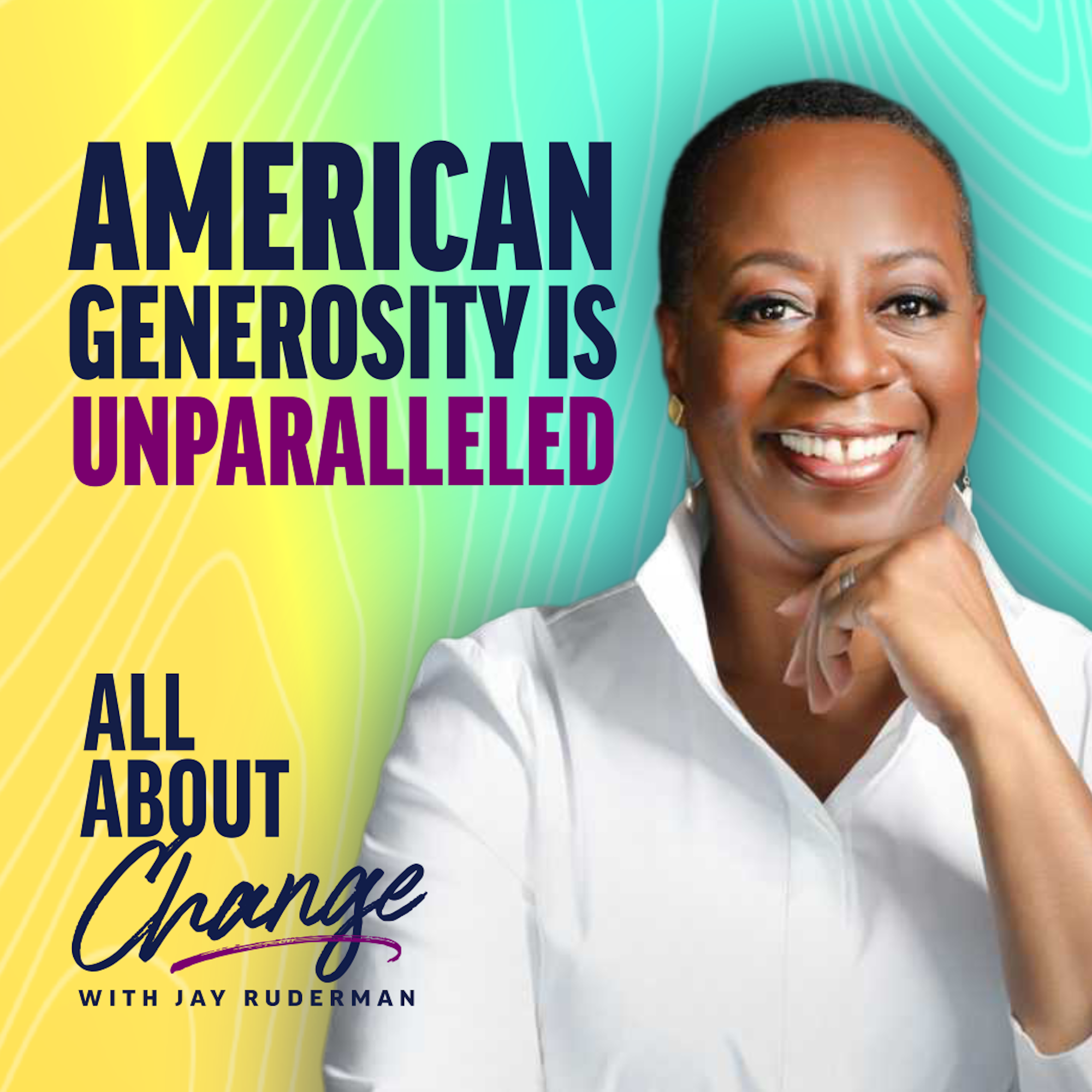
Angela is the outgoing President and CEO of United Way Worldwide, one of America’s oldest and most visible charities, and this position is a culmination of a lifetime of service.She has served in government and led private efforts at the YMCA, Easterseals, and Sears Roebuck.
AboutFor some people, activism is an accident. They come into this work by way of a core issue, and either become experts on that matter, or they expand, becoming experts in activism. But for some, activism is an ethos. A lifelong calling to give and care for others. Angela Williams is one of those activists.
Angela and Jay discuss the state of American giving in 2026, the positive connection between spirituality and activism, and much more.
Jay:
Welcome to All About Change. Hey, All About Change listeners. It’s Jay here, and I wanted to tell you my book, Find Your Fight, is now available in 800 Walmart stores. In the book, I talk about my biggest successes and those of others, and also failures as an activist, and my personal philosophy on how to make a difference. It’s the perfect gift for friends and family who care about making a positive change in our society.
For some people, activism is an accident. They come into this work by the way of a core issue and either become experts on the matter, or they expand becoming experts in activism. For some, activism is an ethos, a lifelong calling to give and care for others. Angela Williams is one of those activists. Angela is now the president and CEO of United Way Worldwide, one of America’s oldest and most visible charities. And this position is a culmination of a lifetime of service. The child of civil rights activists, Angela is an ordained minister, attorney, and civil society executive. She has served in government and led private efforts at the YMCA, Easterseals, and Season Roebuck. It’s so great to speak with such a seasoned activist.
So Angela Williams, welcome to All About Change. I wanted to jump in because we haven’t met, this is our first time meeting, but my research into you shows me that you are one of the most positive people I’ve ever seen in this field. And as you know, advocacy can be quite heavy. There’s a lot of problems of the world, especially you as president and CEO of United Way Worldwide are dealing with issues every single day. How do you keep smiling and laughing and positive through everything?
Angela Williams:
You know what, Jay? I am a person of faith, and I also recognize that in the valley and between the valley are mountains. And that’s my grounding and my mindset to know that there’s this scripture that says all things work together for the good of those that love the Lord and are called according to his purpose. And as a Christian and as an ordained minister, I am constantly preaching hope. As a lawyer, I have always been that advocate for people. And now sitting in this seat as president and CEO of United Way Worldwide, I still believe in the human heart and the fact that neighbors are always willing to reach out and lend a helping hand to their neighbor that’s in crisis.
Jay:
So do you feel that your background, and you’ve had a very diverse background, you’re a minister, you’ve served in the military, you’ve served in the nonprofit world, you worked in the political world, do you feel that your background in many different fields prepared you for tough conversations, for meeting people in the middle, for understanding people maybe a little bit better than people that who take the straight and narrow path?
Angela Williams:
Yes. Let me start, for example, in the military. And when I was on active duty, I was a lawyer in the United States Air Force, and so I was known as a judge advocate general. And in that scenario, and at the time that I was in active duty, there were very few women lawyers on active duty. And so being in the environment that I found myself in, you have to be tough. You have to be able to articulate positions or weigh in or give advice and ensure that people would listen to you.
The same working in a law firm or working in Capitol Hill for example, working for Senator Edward M. Kennedy, Teddy Kennedy, was an awesome life lesson in how do you navigate politics with people that are so divergent from you, but yet remain that friendship and relationship. And that was the secret sauce of Senator Kennedy. And that’s why I will always say that he is one of the greatest statesmen in human history, in the U.S. history, because he could be radically different in terms of his politics. Yet, they would come off the Senate floor, break bread together, have those warm relationships, and that’s what’s key. Never lose sight of humanity.
Jay:
So I did, I’m from Massachusetts, and I did have a chance a couple of times to meet Senator Kennedy. I served as a congressional page on Capitol Hill, so I got to spend a little bit of time with him. And I do agree with you, he was a remarkable leader in the Senate. But when he was in the Senate or in Congress, people spoke to each other. He had relationships with Orrin Hatch or people on the other side of the aisle. This is not a show about politics, but there’s an analogy to advocacy. And now it seems that we do not speak to people who do not believe the same as us. Even in our political world, how do we get beyond that? How do we convince people that that’s really the way to go forward? Because I believe that most Americans are in the middle someplace. They’re not on the fringes, and yet our politics, our advocacy is pulling us to the fringes. And how do we get beyond that?
Angela Williams:
That’s a great question. I’m not sure that I have all of the answers, and I think that’s where the dialogue for bringing people together to think through, again, how do we have these conversations and get past extremes? I honestly think it starts in the home. It starts in local communities. It starts with small groups of people coming together just to talk.
I think it’s also about turning off the noise. I will tell you, so this is the insight into my marriage, right? Now, I stay glued to the TV, always look at the news, go through all of the different news channels, and he said, and his thing is, “Angela, turn off the news. It’s just a bunch of noise that’s going on. And that’s all you hear about this extreme or that extreme perspective.” And I said, “I know, but I just like to listen.” And his thing is, he’s a pastor, “Let’s just go out and talk to people. Let’s relate to people.” And so I really do think that’s what we do. We tune out all of the extremes and begin to humanize each other, the other person, understanding that you may not look like me, your socioeconomic status may be different than mine, but let’s talk.
And I’m going to give you, if you don’t mind, just one real example. So as I said, my husband’s a pastor. He’s been doing ministry in Chicago in one of the low-income housing projects in Chicago, and he wanted to make a difference. So he thought, let me go and talk to the drug dealers, the young kids that are on the street corners and say, “Hey, there’s another way for you. You can get your GED. You can graduate from high school. You can go to college. Let me paint a picture and a vision for a future different than your current trajectory.” And at that time, the young kids were like, “Hey, Pastor Rod, thanks. But you know what? People come and go. We need to know that you’re serious. So we’re fine with what we’re doing on the street corners, but if you’re really serious about changing lives, then we want you to spend time with our younger brothers and sisters.”
And so that’s what he did. So he would still walk the streets. He would grab guys on Sundays with, he would get trash bags and he would just clean the streets and talk to the guys on Sunday mornings. And that created this notion of trust. And hey, this guy’s really serious about being in relationship with us and so we want to now start talking to him. And fast-forward four years later, the gangs and everybody else, they protect my husband. It’s like, “Hey, Pastor Rob, we don’t want anything to happen to you. If there’s some shooting going on down the block, they’re making sure he’s okay.”
But it’s about relationships. And we can judge about people’s lifestyles, their backgrounds and experiences. But at the end of the day, when you show them that you care about them as a person and an individual, that opens up all kinds of doors and dialogue.
Jay:
That is beautiful. I had recently interviewed an actor or singer, Jonah Platt, and he said people come up to him all the time and say, “How do I do this? How do I get started?” And he said, “Just start. Just do something. Just get out there and do something.” And I know with the United Way, there’s so many different volunteers out there doing so many different things and they’re doing. They’re actually going out into the community and doing things, whether there’s an emergency or whether as part of what’s going on in their community. And doing is a very important part of actually accomplishing things, but also making yourself feel like you’re contributing.
Angela Williams:
As you were talking, I had a flashback with one of my colleagues in the rural part, Mountains of North Carolina. And when Hurricane Helene and Milton hit, and as you recall the news and Asheville, North Carolina was hit unexpectedly, and of all of these towns in North Carolina, some of them were washed away, she talked about how she hopped into her car afterwards, was trying to cross over downed power lines and would go in the mountains to those volunteer fire stations.
And in that part of North Carolina, Appalachia, there’s a culture that says, “We don’t really want to engage with outsiders. We’re okay. We’re just going to handle it ourselves.” And she would go and said, “Hey, I’m here. How can I help? I’m with United Way.” And then she would say, “I’m part of you all.” And then when they realized she’s the one that owned the diner down the mountain, they would invite her in and she would always leave, she said, “With a plate of food.” But she always would say, “I’m here to connect you to resources.” And then she would go another couple of miles to the next volunteer fire station to check on people and say, “Hey, United Way is here.”
And that’s that fortitude, that’s that I’m going to understand that I have my own issues that I’ve got to deal with from the aftermath of the hurricane, but United Way is here. We are here to support you. We’re here to help you. We’re here to bring resources to you. Just let us in and we want to make sure that you’re okay. And that’s how United Way has been for 138 years. And we have been in communities before things happen, during things as they’re happening, and we’re there always long after because we live and work and play in the communities that we serve.
Jay:
Excuse me. So I wanted to ask you, Angela, sitting atop the United Way, you really have a brilliant vantage point to assess the needs of people across America and the people that are rising to meet them. What’s your bird’s eye view of American charity, American philanthropy heading into 2026?
Angela Williams:
I truly believe that no other country can surpass American generosity. We have seen it time and time again for decades, how philanthropy has played an important role in the American economy, in local communities, and across the globe. What we’ve seen is that from small acts of charity, whether it’s the child that opens up a lemonade stand to say, “I’m going to sell lemonade so I can raise funds to buy things for people in need,” or what I saw on TV last week, this young girl who looked to be about 10 years old that told her parents, “I’m taking over the garage in our house and I’m going to ask our neighbors to donate clothing so I can give it to people that need clothing and warm coats to organizations like United Way that are 138 years old”, where we work and cover 95% of communities in the United States and operate in 35 countries where our staff are millions of volunteers and employees of corporations that give of their time, talent, and treasure, working alongside us and have done so for over a century, continue day in and day out to focus on their local communities.” And so going back to acts of charity or acts of generosity, we see it on a very small scale, but we also see it on a global scale as well and in a very connected way.
I also want to just mention that there is the 211 Health and Human Services Hotline that has been in existence for 40 years, both in the United States and Canada. People need to know about this resource. If you dial 211, you’re connected to a caring kind operator that will help you with whatever the need is, whether you’re suicidal, whether you’re in a mental health crisis, whether you’re a caregiver that needs resources. Whether you don’t have food, whether you can’t pay your utility bill or you are about to be evicted, whatever the need is, 211 is set up to be able to help people. We take in almost 50,000 calls a day, seven days a week from people that are in need. And it’s not for people that are lower income or whatever. It’s not about your social status, it’s all about what your need is at that moment.
And so again, we show up in communities in all kinds of ways and we are there for people.
Jay:
So I did not know about that, and thank you for putting that out there, and I wish more people would know about that. I think what you’re talking about is how the American people are good people and they care about their neighbors and they care about their communities. And you mentioned that United Way has been around for 138 years, and I wanted to ask you about that because as a country, since the past 138 years, we’ve gone through depressions, we’ve gone through some very difficult times, some natural tragedies, how do the first responders without uniforms keep going in moments of crisis when we go through very, very difficult times periodically?
Angela Williams:
Thank you. I love that phrase, first responders without uniforms, because that’s really and truly who we are. As I said, we’re there before, during, and after crises that happen, and have always done that for more than a century.
I think it’s important to recognize that we in the nonprofit sector really recognize, and if you don’t mind, I’m going to bring in a little bit about the framework for my recent release book because I talk about systems are very brittle. We see where we think we can rely on the educational system and something happens, or we can rely on our financial institutions and then something happens, or we can rely on healthcare systems and then something happens. And so we recognize that they’re brittle. But what we see is when systems break and don’t meet needs, or the government, when it’s on shutdown for the longest time in American history and people are on the brink of losing SNAP benefits, meaning their benefits to buy food or whatever the system is, when it’s brittle, we know that systems like nonprofits are looking at ways to be creative and helping to be bendable and not being rigid. And that’s what we have to continue to do.
Or I will talk about, when I talk about we become anxious about what’s happening and people freeze and don’t know what to do, here comes the nonprofit sector. Here comes United Way, because we become really attentive. I mentioned our 211 call center operators or you can go online. There are people that are willing to listen and understand what the trends are and then bring in other people to make sure that we can be creative.
For example, in 12 hours what United Way did when people were losing their food benefits after the government shut down, we created 211.org, a food resource navigation system where people could log onto our website, put in their zip code, and they could see immediately where they could go find food in their community. And that resource now is still available on our website. But that’s where you’re talking about being bendable, where a system breaks down that you constantly relied on, consistently relied on, and is letting you down.
And so I could go on and on about where things just don’t make sense, and yet when things don’t make sense, that’s when you have to be innovative. That’s when you have to think about partnering with unusual partners and do things differently. That’s the moment that we find ourselves in, and that is what is required of all of us. And leadership, and I use that word, you don’t have to have a title of CEO or president. You don’t have to have a title of executive vice president. What you have to be as a leader is one who sees a need and decides to step up and say, “I’m going to come up with a solution for this moment.”
Jay:
Well, thank you. Thank you for that. I’m impressed. I’m impressed by how quickly the organization can adapt to the real needs that are out there.
Angela, I want to talk a little bit more about your book. So about a couple of months ago, your book, Navigating The Age of Chaos, was released, and you talked about being brittle, and the book hinges on the term BANI, B-A-N-I. And I wanted you to talk a little bit about that and how that gives us a way to understand a chaotic world at this time.
Angela Williams:
So I will give you one example. So we say the BANI, B stands for systems being brittle, A, anxiety or anxiousness, N is nonlinearity and I is incomprehensible.
And so B, where we see systems are brittle during COVID, and this is going to be a story from Australia, during COVID, Australia was on lockdown and then access to food became hard for some people. And so what did our United Way Glen [inaudible 00:20:26] do? They said, “You know what? In neighborhoods, there are these little boxes where people drop off books and they go in, reach out and grab a book for free, and they do book exchanges.” And in fact, here in Alexandria, Virginia, where our United Way worldwide headquarters are, we have one of those same little book things on our front lawn. And they said, “You know what? Why don’t people who have canned food, instead of putting books in, put food?” And so people that have needed food, they can go to that little box and pull out some food.
That’s where we talk about a system that’s brittle, breaking. And then the positive of the B is being bendable. You take an existing system and reuse it to meet the moment. Isn’t that different? So that where we talk about in the book, where systems are brittle, then we can make them bendable and use other systems to meet that moment and come up with a solution.
The A is anxiety or anxiousness. And in that, we talk about where people become paralyzed. So the positive to the anxiety is attentiveness and being attentive meaning that there are people that are unlike you or partners that could be unique and different that you want to lean in with and partner with.
Nonlinearity is the N that we talk about in the book where systems are so complex and then we can’t see a straight line between cause and effect. And when you can’t see how one plus two equals three, then that’s when you need to become neuroflexible. And by that means what we talk about positively, be agile. Be agile. Don’t get stuck. Well, this is the way we’ve always done it. Well, guess what? The way that you’ve always done it isn’t working, isn’t meeting the moment, that’s when agility is required as a leader, as a human being.
And then finally in the book, we talk about the I, which is incomprehensible. And that’s when you say, “I can’t understand what the heck is going on. We’ve never seen anything like this.” And that’s when you have to have the positive to the incomprehensibility and the positive is inclusion. When you have everybody come to your kitchen table, you include all kinds of different perspectives, backgrounds, and experiences and say, “You know what? None of us have seen this before. Why don’t we sit down and let’s talk about it?”
Jay:
It’s so helpful, because I think a lot of us are looking and we’re like, “Wow, this is so different. I don’t understand our politics. I don’t understand the way society’s interacting with each other. I don’t understand the leaps and bounds that we’re making in technology and how that’s going to impact us.” And I was just sitting in a conference on mental health and they were talking about AI and both the positive and negative aspects that that can have on us. So there are so many things that are being thrown at us and I think people are scared.
And the book that you wrote, I think really helps us reframe it and think about it a little bit differently and approach things without being overwhelmed, but actually take today’s life and try to make the best of it and adapt to it. So thank you. And I know that your co-authors are futurists, so they’re thinking about how we can live a better life going into the future.
Angela, thank you so much for being my guest on All About Change. I loved your story. I love your background. I myself have a diverse background and I’m a lawyer and have done many different things in my life, but I think activism is the way to change the world. And I think what’s been so important about your example is coming from the spiritual world, being a minister, being a lawyer, serving in our military, being in the political world, in the corporate world, there’s so many different aspects. And I think that people do not have to pigeonhole themselves. They can have a diverse background and that makes us stronger leaders. It makes us stronger people that contribute to society.
So I really want to thank you for your example. I want to thank you for your service and your dedication because you’ve dedicated your whole life to trying to help our world and you’ve done a fantastic job at that. So I want to thank you and I feel a real kinship with you, even though we haven’t met and we’re doing this over the internet, but thank you so much for being my guest. I really appreciate our conversation.
Angela Williams:
Well, Jay, thank you for your graciousness and I appreciate your kind words. And this is just a wonderful conversation and you continue to be the advocate that you have been and using your platform to encourage others.
Jay:
Thank you so much.
Thank you for being part of the All About Change community. We aim to spark ideas for personal activism, helping you find your pathway to action beyond awareness. So thank you for investing your time with us, learning and thinking about how just one person can make the choice to build a community and improve our world. I believe in the empower of informed people like you to drive real change, and I know that what we explore today will be a tool for you in that effort.
All right, I’ll see you in two weeks for our next conversation, but just one small ask, please hit subscribe and leave us a comment below. It lets us know that you value this content and it supports our mission to widely share these perspectives. If you’re looking for more inspiration, check out this next video. I chose it for you and I know you’re going to enjoy it.
I’m Jay Ruderman. Let’s continue working towards meaningful change together.
Today’s episode was produced by Tani Levitt and Mijon Zulu. To check out more episodes or to learn more about the show, you can visit our website Allaboutchangepodcast.com. If you like our show, spread the word, tell a friend or family member, or leave us a review on your favorite podcasting app. We really appreciate it. All About Change is produced by the Ruderman Family Foundation.