

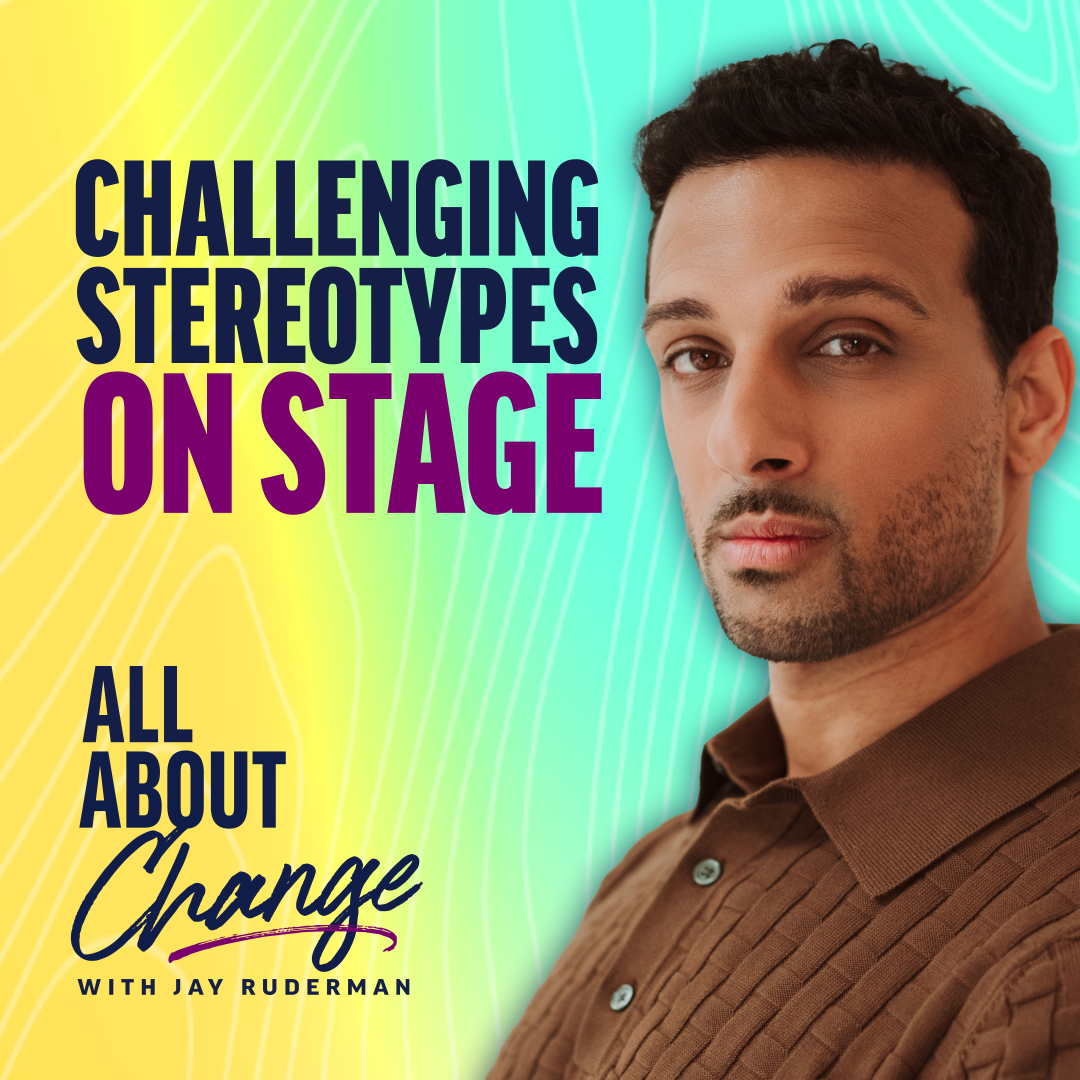
Sometimes the hardest type of activism is the activism that happens inside ourselves. It’s easier for us to give others support and grace when they need it than it is for us to look in the mirror and do the same for ourselves. For recent guests Jeffrey Marsh and Jackie Goldschneider, this internal activism became a platform from which they were able to support others, and today’s guest Ari’el Stachel is doing that same work.
AboutAri’el is an award winning actor of Ashkenazi and Yemenite Jewish descent, and he has long struggled with his mixed identity. But after realizing he could embrace his Middle Eastern identity in a professional capacity, his eyes were opened. Ari’el is now challenging his fear of himself in a brave one-man show called Other. In it, he tackles family history, his mental health challenges, and his profuse sweating, all of which are things that make him, him.
Ari’el and Jay discuss connections, the responsibility artists must carry for their communities, Ari’el’s comfort moving across artistic mediums, and much more.
Jay Ruderman:
Welcome to All About Change.
Hey, All About Change listeners, it’s Jay here, and I wanted to tell you my book, Find Your Fight, is now available in 800 Walmart stores. In the book, I talk about my biggest successes and those of others and also failures as an activist and my personal philosophy on how to make a difference. It’s the perfect gift for friends and family who care about making a positive change in our society.
Sometimes the hardest type of activism is the activism that happens inside ourselves. It’s easier for us to give others support and grace when they need it than it is for us to look in the mirror and do the same for ourselves.
For recent guests, Jeffrey Marsh and Jackie Goldschneider, this internal activism became a platform from which they were able to support others. And today’s guess, Ari’el Stachel, is doing that same work.
Ari’el is an award-winning actor of Ashkenazi and Yemenite Jewish descent, and he has long struggled with his mixed identity. After 9/11, he was called slurs for his Middle Eastern heritage, which caused an internal crisis. He pretended he was anything but Middle Eastern to avoid scrutiny, and even pretend his Yemenite father was not his actual father.
But after realizing he could embrace his Middle Eastern identity in a professional capacity, his eyes were opened. Ari’el is now challenging his fear of himself in a brave one-man show called Other. In it, he tackles family history, his mental health challenges, and his profuse sweating, all of which are things that make him him. Ari’el, welcome to All About Change.
Ari’el, I wanted to start at the end of your show, Other. And it’s been playing for some time, to much acclaim. And one of the favorite parts that you talk about is your ability at the end to speak to audience members. And for me as an activist, these intimate discussions really hit home. I’m wondering, what moments have you taken away from speaking to audience members that have really had an impact on you and had an impact on others who’ve seen the show?
Ari’el Stachel:
One of the things that was really scary about creating my show Other, which was centering my anxiety as opposed to my ethnicity. And that was at the urging of my director, Tony Taccone, who thought that there was something realer underneath.
In framing the show as a story of a person who’s on a journey to overcome or try to overcome their mental health struggles, of course, the conclusion is that one doesn’t overcome it, they hold hands with it. The portal that it opened up for audience members was pretty sensational. Going back as early as the first production in Berkeley Repertory Theatre where people would come to me from a myriad of backgrounds, whether it was people who were in their 70s, who were of Japanese descent and who said, “I remember when my parents were in internment camps, and I had so much shame about being Japanese and I wanted to hide my ethnicity, and I see myself in your story.” There were people who came who were in wheelchairs, and because the focus of my show was on OCD, they felt like it was a show about disabilities. And so everyone had a different moment of entry.
I mean, for me personally, what was most impactful is when there were other Mizrahi American young people, who had been grappling with finding a place in the world, who felt like there was nowhere for them to feel accepted, and that watching me just share my story meant something, made them feel seen, made them feel visible.
It’s a pretty amazing thing to share your story and have it impact people’s lives. But I would say that, and you were just sharing the story about your son who’s dealing with something similar as I am, those are the kinds of things that really mean something to me. And I end up staying in contact with a lot of them on social media and just checking up on them and making sure that they’re good.
Jay Ruderman:
That’s amazing. So you make yourself available at the end of your show and keeping in touch with people. I know many artists and a lot of times they have many buffers and they’re not as accessible. What I love about what you’ve done in your career and in Other is that you’ve made yourself really vulnerable. You’ve talked about things that most people in your industry and other industries don’t want to talk about. They want to keep it silent. They deal with it internally or maybe they talk to someone like a therapist, but you’re dealing with this in the open.
I’m just wondering, how you decided to just bring up what happened in the past and deal with it instead of just saying, “Well, I don’t want to talk about that. I don’t want to tell you anything that could be vulnerable to me.”
Ari’el Stachel:
You may have watched Bad Bunny’s Super Bowl show, and that’s something that a lot of people have been talking about like, what is the responsibility for somebody who comes from a culture that is maybe underappreciated, marginalized? What is that person’s responsibility? And I think for me as an actor, I have two strands of my life. I have the part of myself that set out to become an actor. And then there’s a part of me that is from a very small, misunderstood community at a really, really tense cultural moment for our people as Jews. And for me, it feels like it is a responsibility to tell the story of my people and share it openly.
So I think that when I went to school, when I studied at NYU, the mission for everyone was to be a star. And when I entered into the industry, the mission was to be a star. It was like, how can you get the most high-profile job around the most famous people? So that was the metric that the industry was looking at everything from. And that felt very antithetical to the reason why I got into the arts and the reason why art exists.
And I feel like a lot of people say, “You really expose yourself, you talk about your mental health struggles, you talk about your struggles with your identity. Why do you do that?” For me, I see it as it’s no other option. It is the responsibility to my culture, to what I’m going through. And I think that we all have our responsibilities in society. And I think if you listen very acutely to that voice, which I try to listen to very acutely, that voice says, “The way you make an impact is through your art. And through your art, you try to deal with these things that we’re all hiding, we’re all dealing with in real time, but we’re not talking about.”
And I just think of that as the responsibility of the artist. And I also think of it as maybe the tikkun olam of my Judaism, which is to say that what I am after as an artist isn’t necessarily just self-serving. I mean, of course, there are wonderful moments, and it’s great to win awards and all these things, but more importantly, how can I use my God-given talents and what I used, what I sharpened for years and years in training to try to make the world a slightly better place? And for me, it was to be out in the open, proud about my community and my culture, and also about the struggles that I go through that I think a lot of young people are going through.
Jay Ruderman:
I want to get into that a little bit more about the time we’re living in. And you talked about, in the aftermath of 9/11, that victims of an act of terrorism, a worldwide act of terrorism, that out of their fear, they start inflicting their negative feelings on others. And you talked about being on a basketball court and people calling you a terrorist, and so many people of Arab descent were picked on and accosted post-9/11. And now we’re living at a time where it feels like every week, almost every day, there’s something on the world stage, on domestic stage that is creating a new set of people who, out of fear, could be inflicting their pain onto others. And I’m wondering what advice you would have to people who all of a sudden both are victimizing other people maybe because out of fear and those that are being victimized, and how would you recommend they handle the situation?
Ari’el Stachel:
I just to harken back to what you said, I was 10 years old when 9/11 happened, and my dad, as a Yemeni man, resembled the Osama bin Laden, and so he was called the Osama bin Laden. And so I did everything I could to avoid being associated with that because I wanted to just be a kid and be cool.
And so it took me about 8 to 10 years to feel comfortable saying that I was Middle Eastern and that I was of Yemenite heritage. It took 10 years. And in those 10 years, a lot of hiding, a lot of concealing.
And I felt after that, coming out 10 years after that, that that would be the last time that I would wrestle as intensely with my own identity. I was mistaken because our identities are always in conversation with the world.
And of course, in the aftermath of October 7th, living in a Yemenite Israeli Jewish body has become far more complicated even than what it was when I was a kid, but I’m an adult now, and so you deal with it in a different way.
I hope this doesn’t sound pessimistic, but I think for some people of some backgrounds, there takes a bit of audacity to be who you are in the world. And so to those who feel victimized, I mean, I think the sooner that we wrap our heads around the fact that we can’t please everyone and we can’t be liked by everyone, the better.
But I’ve also noticed that the negative atmosphere has led a lot of people to behaving in a way that’s very antagonistic and the energy is very, very negative. I’ve seen a lot of Jewish activists feel very negative and angry. I choose to just celebrate what I am. I choose to lean into the elements of my culture that I feel very proud of.
Though there is a lot of ignorance and hatred in the world, I find that for me, the way that I can live and enjoy every day is to simply celebrate what I am, which is audacious.
In my show, I opened my show Other prior to October 7th. And in the show, it was just the fact that I was Israeli. It wasn’t really a political statement. And there was a moment that I dramatized earlier in my life where I was at a Jewish day school and I start using an Israeli accent to make other kids laugh.
Well, after October 7th, when I made that joke, I would have a little quiver in my soul because I wondered what kind of judgment am I getting from the audience by simply stating that I was a fourth grader imitating my Israeli father’s accent.
And so after I felt that little bit of tension, I went home, and then I thought about it, and I was like, “Well, you have to be audacious.” And it’s also audacious to not lean into hatred. It’s audacious to celebrate what you are because in spite of all the hatred, my sense, and I’m speaking specifically of my background, when I think of Israel, I don’t think of war. I think of my beautiful family who arrived from Yemen, I think about wonderful summers, I think about my father growing up on the beach. And I think about my grandfather who arrived from Yemen, who was so happy just to be able to pray in peace and who felt like he was following his holy mission. And so there’s real beauty in those memories. There’s real beauty in my grandfather’s story.
And so this is a very roundabout way of answering your question, but our history, in many ways, is beautiful, our cultures are beautiful. And I think that the way that those who feel victimized celebrate with love.
Jay Ruderman:
I want to talk about something that’s very beautiful about you and your ability to adapt and change. Post-October 7th, you made some updates to Other and you decided to leave The Visitor in 2021. You’re constantly making choices that reflect the changing reality in the world. And I see that you have a resolve that reflects your values and that meet you as you move, and that your ability to take your philosophy and art and have it to adapt to the time of what you’re feeling and what you’re experiencing then.
Can you talk about how you came to that? Because there’s so many people that says, “Well, I’ve always believed in this, and this is my position. I never change my position.” But you’re like the opposite, saying, “Well, yeah, things are different, and I’m now going to change and talk about how it’s impacting me.” How’d you come to that beautiful sort of way of adapting to the world?
Ari’el Stachel:
First of all, that’s an honor to hear you frame it in that way. Thank you for that.
Jay Ruderman:
Thanks.
Ari’el Stachel:
One of the reasons why I’ve adapted so much is because I left school … Well, I had a dream of being an actor, start there. I was 15 years old when I wanted to be an actor. I got into NYU, and you look around your class and you decide, “Well, three of us might make it to Broadway out of 50.” That’s the odds. And I ended up not only making it to Broadway, but winning a Tony Award my first outing on Broadway. And it is a great blessing and a great curse. And the curse is that it happened at such an early age that you kind of … the goalposts had to change. And I would say that for me, it really, really quickly, and I think a lot of people who experienced these pinnacles of success come to this conclusion, I think I’m one of many who realizes, “Oh, this hasn’t solved anything. Shit.” And so your body, if you’re listening to your body and your instinct, leads you in different directions.
And so when I won that award, that’s a rare moment for an actor. And my agents and my managers wanted to cash in on it, just try to get a Marvel film or make money. And I wanted to sit in a corner and write a little play. And that’s not the most lucrative path to go on.
I can’t seem to live inauthentically. The cost is too great to move against my instincts. And so the answer to your question is that not only have I changed and adapted, I’ve also adapted mediums. And I’ve found that as I get older and as the world changes, there are new mediums that speak more to where I am in a particular moment. So one is interpreting as an actor, and then the next stage for me was writing and performing. Now I’m in the process of writing a book. I have interest in doing podcasts.
And I think that the question that I ask myself is, how can I be additive? How can I be additive? And when I ask that question, the medium reveals itself naturally.
I’m an artist, I’m not a neurosurgeon. The only way that I can change the world is by articulating something in a way that is not heavy-handed, but that is through expression and through vulnerability. And so I just, without sounding really precious about what it means to be an artist, I do think that that is what the artist’s role is in society.
Jay Ruderman:
Ari’el, I want to talk to you about and ask you if you’ve had any reaction about your show in Israel. As recently as 2023, there was a Sephardic member of Knesset who was talking about Ashkenazim, saying, “They’ll give us some things, but they won’t let us rule.” And reflecting the sentiment that Sephardim have a less-than status in Israeli culture and politics. And obviously their experience is not the same as yours, but with many prominent Sephardim in Israel, have they connected to your show and your message and what you’ve talked about?
Ari’el Stachel:
This is a great question and it’s very loaded, and I’m going to answer it as truthfully as I can. As far as Israel is concerned, it hasn’t necessarily penetrated in Israel yet. I mean, there has been conversations about bringing it into Israel, and I likely will, and so that will probably make it more of a conversation.
But as far as the Sephardic community in the United States is concerned, my desire to not fight and be unifying, I think to many members in Sephardic community, is seen as maybe weak. And I think that, and I’m just being honest, I think that I started to call myself an Arab Jew on Instagram, which really incensed people, but it mostly incensed Mizrahi Americans and Mizrahi people who felt like we had lived for centuries in these lands and we’re always second-class citizens. How dare you connect yourself in name to communities that abused us?
So how that relates to my show is like, it was very interesting to do my show because, to be frank with you, I mean, the theater-going audience is New York and Ashkenazi. So that was my biggest demographic in the audience. And it was really, really interesting to share a Mizrahi American story because it seemed like there were a lot, more often than not, a lot of people who were really receptive and really got it, but then there were a lot of other people who didn’t get it. And they didn’t get it because there was an element of my story that is about what it means to try to belong as a person of color in this country.
There were people who just couldn’t empathize with that experience of what it meant to try on new identities over and over. And so some people said, “Oh, it was a little cyclical. You’re doing the same thing.” But I also found a lot of people of color, African Americans would say, “Oh, I really get your story.” So that’s almost why it’s called Other, because it really is about not exactly fitting into any specific community.
But specifically when it comes to what it means for Jews of the Arab world to feel like second-class citizens, I’m still fighting that fight. And as successful as the show was, it still didn’t fit in a palatable way into the way that we see Jews. And so it was still almost a fight to make it clear that this was a Jewish story.
Jay Ruderman:
Right. It’s interesting, what you said resonates with me as someone who’s married to a Sephardic woman and spends most of my time in Israel in the Sephardic community. I’ve heard this sentiment: “No, we’re Jews, we’re not Arabs.” But when I look at the culture and the music and the food, it’s exactly the same as the Arab community. There’s a lot of connections there. And I think for political reasons, because of what’s happened since the establishment of the state of Israel and before, I understand where someone like your father may say, “What do you mean? I’m Yemenite and I’m Jewish.” But the connections, the foods, it’s just, there’s too many overlaps there.
Ari’el Stachel:
The overlap is unbelievable. And I do a lot of my writing at a cafe called Qahwah House, which is this new chain of Yemeni cafes that is actually now almost all over the country, but it started in Williamsburg in Brooklyn. I go there almost every day, and all of the guys who work there are Yemeni Muslims, and there’s a feeling in our eyes of connection.
And there’s one particular guy, actually two of them came to the show, and they learned that I was Jewish during the show. And I was a little bit nervous about their reaction, and nothing changed, nothing changed.
Nation states and politics make things really, really complicated, but people, on smaller interactions, are able to overcome and bridge these differences. But I have always felt, particularly my life was so affected by the perception of my being Arab, which was also a complication because I go home and I say, “Ab, they’re calling me a terrorist.” He’s like, “What do you mean? We’re Jewish, we’re Israeli.” So he’s completely disconnected from the reality of his son who’s experiencing the world as an Arab American kid.
I mean, so I do have good news. I am going to start a social media series that’s being sponsored, and I’m going to work with a researcher to uncover the DNA and get to the bottom of this. And so I’ll have more answers soon.
Jay Ruderman:
That’s awesome.
Ari’el Stachel:
I wish that we could look at our similarities more because I see things how you see things.
Jay Ruderman:
Yeah. I want to transition a little bit and talk about anxiety. I had Kevin Love on the show a while back, and I think you know his story about having a panic attack in the middle of a game and coming out and talking about his anxiety and being very forthright. And you’ve also talked about it. What I’m very curious about is how does having anxiety go along with being a performer and getting up on stage, which is, to me, would be the most anxious situation? How do you marry the two together?
Ari’el Stachel:
First of all, I want to say that Kevin Love, each time somebody who I admire comes out, it makes my shoulders drop a little bit. So that really meant a lot to me when he came out. And so I stand on his shoulders in some way.
The way that I’ll answer it is not the way that you might expect the answer to be, which is that there are so many different ways that anxiety is an incredible asset to a performer and other ways in which it’s in hindrance.
Living with OCD, as far as it lives in my body, means that you are attuned to a level of detail that is abnormal. And so when I was a kid, I would observe things about how people would speak or an accent or the way my dad would speak, and I would get obsessed with it, and I would repeat the dialect and the accent over and over until I learned how to play these characters.
Then, of course, in the aftermath of 9/11 and trying to conceal my Middle Eastern identity, that also required a level of character-playing. And so I survived by having to be really, really aware of how I was coming across, how I was speaking, and how other people were speaking. And so on that level, when you have that level of ability to focus, it is a great asset towards being an actor because you have to pick up on things that other people aren’t picking up on.
And then here’s the other side of it that people don’t understand. People say, “How can you go on stage in front of thousands of people but be anxious?” I say that when you have anxiety like I do, you’re living at a time signature that is very, very intense. I don’t know if you know anything about music, but if it’s like one person at 4/4, this is like 12/9. It’s the beat is moving more quickly than the average person. I’ve come to understand that later in life.
And so when you go on stage or, in my case, a solo show for 90 minutes, that level of intensity is where I feel calm because it’s matching my tempo. So it’s actually in more normal settings where I’m uncomfortable. It’s dinners, it’s cafe, it’s places where I don’t get to live at the depth of my soul. And so I live and look for places where I can be my full, unbridled self. One of those places is on stage.
Jay Ruderman:
Right. It’s interesting.
Ari’el Stachel:
And so that’s kind of the kind of weird answer that I would have for you, that it’s normal life that feels uncomfortable.
Jay Ruderman:
So that makes sense because I guess when you won the Tony, you were up on stage, that felt really exhilarating. And then in the aftermath of, “Well, I won it and now people are approaching me,” that feels uncomfortable for you.
Ari’el Stachel:
It’s so funny, and I’m writing this book now, so I’m starting to explain it with greater depth and explore it with greater depth. But people will ask, “How can you give a speech like that? You look so confident.” But here’s the thing about a speech: a speech, anything can happen and it’s acceptable. You can cry, you can snot. We love it, we love it. And so that’s one of the spaces where you can be anything that you want to be and it’s acceptable. And so for someone like me, that’s give me a lot of freedom.
On stage, there’s a lot of freedom, especially when I’m talking about my mental health, because for the first two years of development of my play was all about ethnicity. And my director said, “Focus on your anxiety.” And when I talk about it in the first three minutes of my play, now I’m free. And so you look for places where you feel free.
And yeah, it’s where you’re wanting to be something that you’re not where the anxiety hits. It’s like, “God, I wish I was actually as smooth and as confident and as cool. I wish I was all these things.” And when you feel like there’s a gap between those, that’s when it hits. And so it’s an ongoing process of self-acceptance.
And yeah, the only thing that I’ve come to through the exploration of my play is that I’ll be dealing with it for the rest of my life, and that that level of acceptance has been a huge step towards healing.
Jay Ruderman:
But you’re also pushing yourself, which, as an artist, you’re constantly putting yourself out there. I remember Michael Douglas saying that before he used to perform, he would throw up, and then he would go on stage. So it’s like you’re experiencing things, but you’re also … it’s not stopping you, it’s pushing you forward, which is a lot of people wouldn’t react that way. A lot of people would say … In terms of activism, people say to me, “Well, I don’t know how to start.” And I remember when I was interviewing Jonah Platt, he’s just like, what he tells people is, “Just do it. Just start something, do something, and it’ll turn into something.”
Ari’el Stachel:
Totally. I mean, yeah, pushing oneself to … I mean, it takes audacity, it takes audacity. You’re taking up space in the world, and it’s vulnerable to do it. And I always say that, I think we spoke about it when we first spoke and when we first started this podcast and now, there’s the fear and then there’s the mission. And if the mission and your belief is stronger than the fear, then you’re going to push forward.
And I think for me, it’s these missions that I feel are in my DNA. This mission to say, “Hey, I’ve been dealing with this thing, OCD, my whole life. I’ve been ashamed of it, I’ve been embarrassed by it. It’s been haunting me, it’s controlled so many elements of my life. The one thing I’ve never done is talked about it with people and been open about it.” And so on some level, that’s another battle for it. But my God, I think there’s nothing more freeing than truth and revealing yourself and just that everlasting journey of self-acceptance.
Jay Ruderman:
Well, Ari’el Stachel, thank you so much for being my guest in All About Change. I really enjoyed this conversation, and I wish you to go from strength to strength.
Ari’el Stachel:
Me too. Thank you so, so much for having me.
Jay Ruderman:
Thank you.
Thank you for being part of the All About Change community. We aim to spark ideas for personal activism, helping you find your pathway to action beyond awareness. So thank you for investing your time with us, learning and thinking about how just one person can make the choice to build a community and improve our world. I believe in the power of informed people like you to drive real change, and I know that what we explored today will be a tool for you in that effort.
All right, I’ll see you in two weeks for our next conversation, but just one small ask, please hit subscribe and leave us a comment below. It lets us know that you value this content and it supports our mission to widely share these perspectives.
If you’re looking for more inspiration, check out this next video. I chose it for you and I know you’re going to enjoy it. I’m Jay Ruderman. Let’s continue working towards meaningful change together.
Today’s episode was produced by Tani Levitt and Mijon Zulu. To check out more episodes or to learn more about the show, you can visit our website Allaboutchangepodcast.com. If you like our show, spread the word, tell a friend or family member, or leave us a review on your favorite podcasting app. We really appreciate it. All About Change is produced by the Ruderman Family Foundation.