

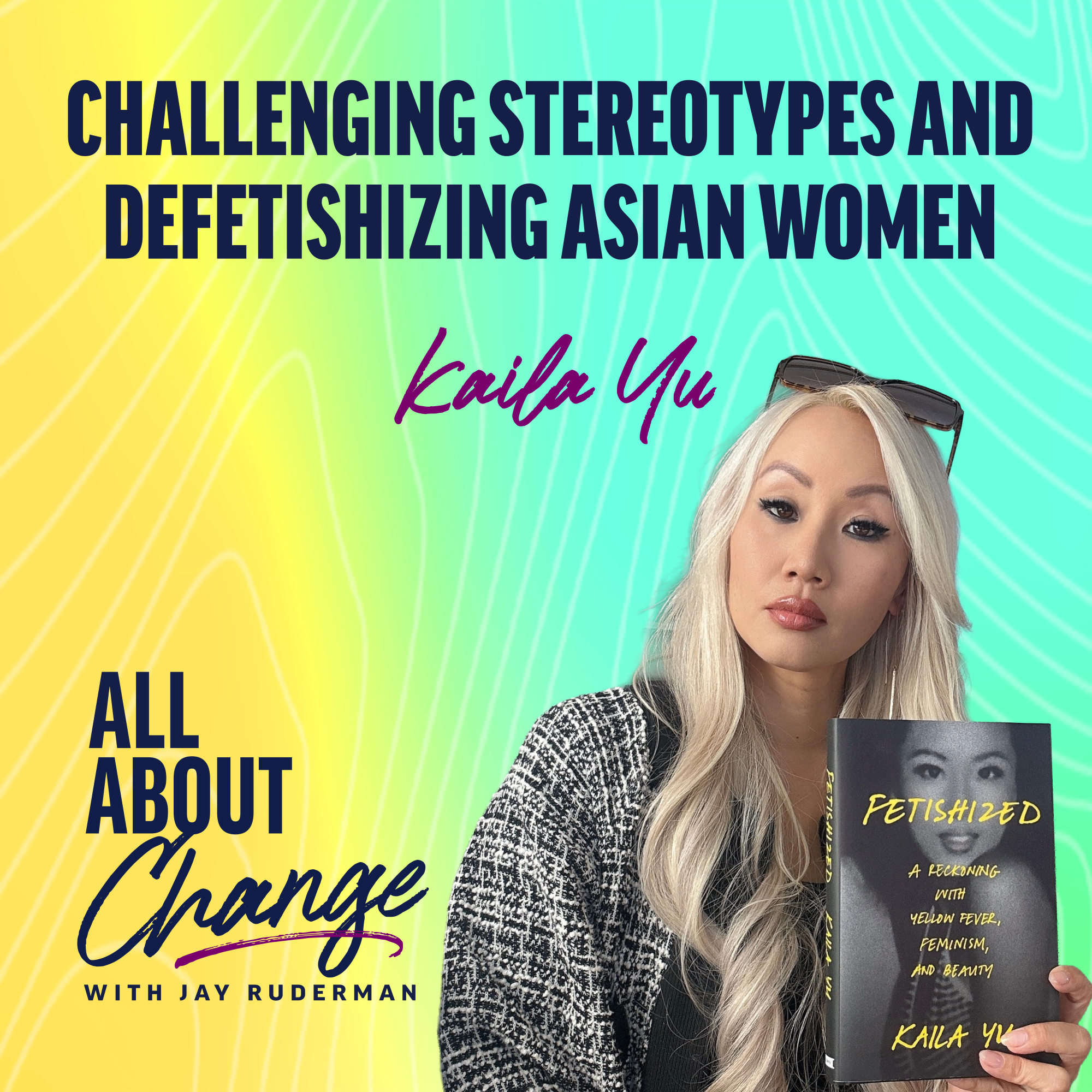
Kaila Yu lived many lives before she decided to write a memoir. As an actress, musician, and import model, Kaila learned firsthand about all the ways it is challenging to be Asian American, particularly as a woman. But she didn’t write about that experience until seeing her fellow Asian Americans attacked and vilified in 2020.
AboutNow a travel, food and culture writer, she has released a memoir titled Fetishized: A Reckoning with Yellow Fever, Feminism, and Beauty. In this book of essays, Kaila challenges the pressures Asian American women face to perform for the white male gaze and details some of the history surrounding that social pressure.
With Fetishized, Kaila is shining a bright light on a specific prejudice in our country and I am excited to amplify that light with our conversation today.
Jay Ruderman:
Welcome to All About Change. Hey, All About Change listeners. It’s Jay here, and I wanted to tell you about my book, Find Your Fight, is now available in 800 Walmart stores. In the book, I talk about my biggest successes and those of others and also failures as an activist and my personal philosophy on how to make a difference. It’s the perfect gift for friends and family who care about making a positive change in our society. Kaila Yu lived many lives before she decided to write a memoir. As an actress, musician and import model, Kaila learned firsthand about the ways it is challenging to be Asian-American, particularly as a woman. But she didn’t write about that experience until seeing her fellow Asian-Americans attacked and vilified in 2020. Now a travel food and culture writer, she’s released a memoir titled Fetishized, a Reckoning with Yellow Fever, Feminism and Beauty.
In this book of essays, Kaila challenges the pressures Asian American women face to perform for the white male gaze and details some of the history surrounding that social pressure. With Fetishized, Kaila is shining a bright light on a specific prejudice in our country, and I’m excited to amplify that light with our conversation today. Kaila Yu, nice to meet you. And thank you for being my guest on All About Change.
Kaila Yu:
Yeah, thank you so much for having me.
Jay Ruderman:
So first, I want to offer you a huge congratulations. I know you’ve been working on your book for three years, and it’s a huge accomplishment to publish. I also just published a book on activism and how to be a more effective activist, and that took me years, and I know what the process is like. And so anyway, congratulations. On a personal level, I know it must be very gratifying to release your memoir, but I was wondering what the reception was like within the Asian American community at large, and have people responded in the ways that you had hoped that they would respond?
Kaila Yu:
Yeah. Well, the book’s about the fetishization of Asian women, so I always knew it would resonate with Asian women because pretty much every Asian woman in America has experienced fetishization in some form. But what surprised me is that, also, Asian white and black men have been reading the book and just being so surprised that they know a little bit about the concept, but not deeply. And just being able to see it from a female point of view was very eye-opening, they said. Yeah, it’s surprising to me that men are enjoying it because they weren’t exactly the target audience.
Jay Ruderman:
So I know that you talk a little bit about the history and American soldier servicemen serving abroad in Asia and being exposed to what was called comfort women or people that were serving in the sex industry. What developed from there? How did it come to America? And how did this, in your opinion, or what you write about, how did this become a thing in our culture where Asian American women, in particular are fetishized?
Kaila Yu:
Yeah, that’s a hard word to pronounce. I’m finding nobody can pronounce it. And I had to learn how to pronounce it for the audiobook. But one of the aspects of why I believe the fetishization of Asian women exist is because of military conquest and imperialism, just basically because the bulk of American men encountering Asian women, say back in the early 1900s was through prostitution because basically after the Philippines war, after World War II, after the Vietnam War, soldiers would be basically rewarded by what was called rest and recreation, and they would be sent to a nice location, say Thailand, Bangkok, where they could rest and relax, and basically prostitutes were a part of the package. So just the idea that the Asian women they were meeting were prostitutes and they weren’t really meeting any real women as much. So yeah, that’s part of the reason.
Jay Ruderman:
And so that is what brought it over to America. Is that why you think that there’s a huge… Well, it’s probably not an overwhelming part of the culture, but it’s a significant enough part of our culture where it’s a thing.
Kaila Yu:
Yeah. So I think the soldiers bringing back that idea, but really it was media. So movies like Full Metal Jacket, everybody’s heard, “Me so horny.” But not everybody knows that it’s from that movie. And I think most people, now, haven’t even watched the movie.
And then that’s one phrase, me os horny, was taken into the 2 Live Crew song and made viral basically. And everybody knows that they associate it with Asian women. And it’s a common thing to just be walking along the street, maybe not so much these days, but when I was growing up and have someone yell, “Me so horny” at you. And not even really know the history behind it. But another aspect is that the first Asian women who came to America were, I don’t want to call them prostitutes because they were more like sexual slaves. Basically, when the Chinese first came over to basically do indentured servitude for our railroads and to build other projects, they were not allowed to bring any women with them. So they couldn’t bring their wives, their sisters, their moms, or anything. And it’s natural for men to want female company, and they were not allowed to date white women or any other women, that wasn’t allowed at that time.
So the gangs would import captured women or sold women as prostitutes in horrible conditions where they had to live in these little box rooms. And when they got too sick or got a STD, they were just thrown onto the street to die. But then the community just thought of the Chinese and Asians as dirty and diseased and these slave women were an example of it, even though they are no representation of what an average Asian woman is like. So it was written about in health journals, how Asian prostitutes are spreading these horrible diseases and working with minors and just being a scourge on society that we had to get rid of. So that was another contributor.
Jay Ruderman:
So I’m just very curious as to why we didn’t progress as a society from that period in history, which was a terrible period in American history to, let’s look at you personally. I mean, you grew up in a small town in California, pretty sheltered, a good family. And how did you fall into this sort of mindset of, well, I need to present myself in a certain way in order for society to find me attractive. And why did you think that was important?
Kaila Yu:
Yeah, so it’s progressed so much now. It’s unbelievable how much Asian representation we have now. But when I was growing up, say in the late ’90s and 2000s, there weren’t barely any Asians on TV. What the hell is an import model? That is a question I get asked all the time. I mean, simply put, it’s just pin up models, mostly Asian that post in front of JDM cars Japanese domestic market. They’re not so big anymore, but they were big in the early 2000s. Pretty much every Asian American knows what an import model, but nobody outside of the Asian community knows what one is. So we weren’t like real models like high fashion girls or anything. There’s a hierarchy in modeling. Still, import models were significant in Asian American culture. I would argue that they defined golden era of the import scene in the 2000s. Back then, we had almost zero representation on film and TV.
Social media hadn’t even really started yet. Our shows like [inaudible 00:08:52] became these huge phenomenons because Asian Americans didn’t have anywhere else to gather. The import models became mini celebrities within the Asian American community. And the import racing scene eventually inspired the Fast and Furious franchise. Did you know any of this?
The few ones you would see was, oh, there’s a prostitute or a massage girl in some movie or a karate fighter. And I felt very invisible when I was growing up. I was very nerdy and shy and I was naturally looking for role models on film and TV and didn’t find any. I liked boys, but they didn’t like me at all. So I just felt very, very invisible. And then somewhere around that time, the movie Memoirs of a Geisha came out and the book. The book first. I read the book and I was absolutely in love with it.
I probably read that book a dozen times growing up at least because it was the first time ever seeing Asian women presented in an attractive light because I had never. I mean, I’d seen them prostitutes, but that’s like not… I don’t know the word, but it’s not ideal.
Jay Ruderman:
It’s not something you aspire to be.
Kaila Yu:
Yes. And then Memoirs of Geisha, they are still essentially in this telling of it, they’re still prostitutes, just very high class ones. But then it was like, oh, at least it’s aspirational because they are living these glamorous lives. And then the movie came out, both the movie and the book were mega-million dollar selling sensations that were huge influences on the culture. And then the author, Arthur Golden, was a man who was white, which is totally fine, except that he presented very orientalized views of Asian women, very stereotypical views. And the funny thing is that the book is presented as a memoir. So a lot of people don’t even know it was written by a white guy. They just thought an Asian woman wrote it, even though his name’s clearly on the book cover, but the way it was presented was as that. It’s a beautifully written book and it’s a gorgeous movie, but he presented… The crux of the movie is that this young underage Geisha is selling her virginity, and that’s the major theme of the movie.
When you speak to any legitimate Geisha, they say this is categorically not something we do. But this was presented like every Geisha does this when she comes of age. So then it’s not surprising that Western men who may not have encountered Asian women too much in their lives have this gorgeous presentation and kind of associate it with Asian women generally. It’s not surprising to me.
Jay Ruderman:
Who is the intended audience for this memoir? People who have lived similar experiences to you, who need to feel seen or the people who are doing the fetishizing, who need teaching to act like decent people?
Kaila Yu:
Yeah, that wasn’t the intention. It was for the women because my story’s a very extreme example of playing into fetishization. The average Asian woman has not done the things I’ve done, but every Asian woman I’ve spoken to at least has experienced fetishization, like some comment by a creepy guy. What I found kind of surprising was that there wasn’t a single book written about this topic, was part of the reason I wrote it. And yes, for men that have the fetish, I don’t know if I’ve spoken to any of them that have read the book. I’ve spoken to men who perhaps have a preference for Asian women. And that’s the big argument. Is it a preference or a fetish? And in the book, I explained very clearly that a preference is one thing, but a fetish, to my definition, is that when a man dehumanizes a woman and treats her as a sexual object and a caricature and disposable.
And I don’t think that’s most men that are dating Asian women. It’s a small portion of the population, but they’re very vocal.
Jay Ruderman:
Right. And what role do you think pornography plays into that?
Kaila Yu:
Oh my God, pornography plays such a huge role. I think pornography is very damaging. Maybe not so much of the pornography I grew up with because it was still big movie production porns with studio systems, right? But the style of pornography that’s popular now is so violent and degrading to women. There’s been studies written that the percentage of r*pe shown for Asian women in pornography’s higher than other ethnicities and Asian women are very, very typically or commonly stereotyped into specific roles in pornography. So I think it’s a huge factor these days.
Jay Ruderman:
So when you say that you talk… that your book is mainly geared towards other Asian women, when they talk to you about your book, what is the takeaway? Because you said most Asian American women have experienced some sort of fetishizing. So what is your takeaway? How are they internalizing the message that you’re putting out there?
Kaila Yu:
I don’t know if there’s a specific message to Asian women except that it was giving voice to what they’ve all experienced. So it’s like a collective being seen. I think the message, I guess, more is for a wider audience is that fetishization isn’t harmless because I think a lot of the times when Asian women get angry at being fetishized, the fetishizers say, “But it’s a compliment. We like you. Why are you so mad about that?”
But in the book, I kind of draw the line between where it originates in war and r*pe and ends in real life violence, not a rare portion of the time. And I also say, the books also for all women generally, because even if they haven’t specifically been fetishized, I think pretty much all women have been objectified and there’s a lot of themes that are very similar to general objectification.
Jay Ruderman:
So you’ve had a really interesting life and career. I mean, from a model to doing some acting to being in a band solo and then with a group, a journalist and a travel writer, and you’ve done so many different things with your life. And then you wrote this book. Did you feel that you were becoming an activist? When you wrote the book, was that something behind it? Or when did you realize that you were talking about something that society needed to know about and that you were becoming a leader in this field?
Kaila Yu:
Yeah, I would say that that’s totally accidental. I became a travel journalist after all the entertainment career stuff. And basically what happened was the pandemic happened and the president basically called it the Chinese virus. And I grew up in a mostly white neighborhood and I didn’t experience outright racism really, and definitely not on a daily basis or anything like that. And suddenly it was like what was disturbing I think for Asians to see was like, this was what people were thinking, some people were thinking this whole time, but now they have permission to say it out loud because basically the president said, “Go ahead.” We’re all stuck at home watching these viral videos of people shouting, “Go back to your country,” to people who were born here or beating elderly people to the ground and pushing them into subways.
So I think even though I was a travel and food journalist, there was no way as an Asian American I couldn’t be also writing about these issues. So yeah, I started covering these issues on social media and in media writing during the pandemic, and then a year later, the Atlanta spa shootings happened. So that’s when the young man went into three different, I think, massage parlors and shot eight people dead and six of them were Asian women. And of course, I think when Asian women heard these details, they knew exactly that it was fetishized and sexual violence. And the media has never recognized that to be the case. I don’t think he was charged with sexual or racial motivation or whatever that is or hate crime. Later was revealed that he had a sex addiction he was trying to get rid of. So yeah, the book was kind of born out of that. I never planned to write a memoir about my life. It kind of just came out of writing about these topics.
Jay Ruderman:
I think about that also because with activists, they’re opening themselves up and they’re all getting, especially when people can hide in social media, they’re getting terrible hate. But I always think, and I tell people, they don’t really know you. They don’t know your family. They don’t know your friends. They really don’t know who you are as a person. You become sort of like a figure out there that they can say something about. But when it happens to me, I look at it and I’m like, well, they don’t know me. They don’t know me. It’s not like my best friend is saying this to me.
Kaila Yu:
They’ll never say it to your face. I mean, say it to my face and then we’ll have things to talk about. But yes, it’s so easy to just hide in your room anonymously and say the most horrible things.
Jay Ruderman:
So I want to take into account of all that you’ve experienced in your career, the healthy, the otherwise not healthy, changing your name, modeling, performing with Nylon Pink and writing the memoir. Do you think you have a positive vision for what healthy Asian American representation in American culture should look like?
Kaila Yu:
Yeah, I feel like we’re seeing a lot of it now. There’s been so many. Okay, I always say it’s so shocking to me to turn on the radio and hear Korean and see young kids learning Korean just so they can understand Korean dramas and K-pop and sing K-pop. That has been so huge. And then so many movies that present multifaceted Asian people who are not perfect. Like Beef. I absolutely loved Beef because the characters were messy and real. They weren’t model minorities or they weren’t highly sexualized. And nowadays, there’s countless Asian musicians and actors. I don’t even know them all. Literally when I was growing up, I can name you every single well-known. I was basically Lucy Liu.
Jay Ruderman:
Do you think that she was transformative in our culture in terms of representation?
Kaila Yu:
Absolutely. I mean, there’s a chapter in my book titled Lucy Liu, and the thing is, some of the Asian American population believes, I guess including me, because I wrote it, that she did play into some Asian stereotypes like The Dragon Lady. Lucy Liu does not agree, just to state that. So I don’t know if she’ll like that chapter. But what I say is that I was an actress too. I would’ve taken any of the parts she played in one second without question, as would any Asian actress at the time, because that’s all that was available. And also, as actresses, we don’t generally, not we, because I’m not an actress, but actresses don’t generally get to write their roles, right? They’re just working on what’s available to them. What she’s done is transcended that. She took that and now she is playing parts that are not at all stereotypical and are far beyond, and she broke the door wide open for all Asian actors, period, I think, with her career.
Jay Ruderman:
Do you now see yourself as an activist on this issue? Are you going to continue to speak out on this issue?
Kaila Yu:
Yeah, I feel like I’ve, not just specifically on fetishization, but just on women’s rights. And I think it is important to speak on that right now, especially. I’m definitely aligning with and speaking to some sexual violence or survivors companies and maybe speaking and aligning with speaking with them at different events next year. So yeah, it’s definitely… I think everyone needs to speak about these things. Everyone needs to be an activist right now.
Jay Ruderman:
And now that you have a platform, you have the ability to really speak out when it’s called for. I mean, I read an article recently that you’d written about reality TV show in which one of the characters was using derogatory language, and you wrote an article about that and explained why it was an issue when some people were saying it wasn’t an issue. Do you want to talk a little bit about why you wrote that article and what that was about?
Kaila Yu:
Yes, that was definitely an online viral controversy, but it was about the dating show, Love Island, which is probably one of the biggest shows right now. And there was a contestant on there named Cierra Ortega. And I actually don’t think that she was trying to be insulting, but basically she was saying, she used the C word that refers to Chinese people’s eyes and she kind of did the gesture, I believe, with the eyes and said, oh, my eyes are looking too C-word. I need to get Botox or something. She said something to that effect, I’m totally paraphrasing. What was illuminating about that is that a lot of people don’t realize that’s a slur. People genuinely didn’t know, and I think she genuinely didn’t know. So it’s unfortunate that I guess she said those words in relation to her eyes because she was basically saying, my eyes look too Asian, I need to fix them. And she’s apologized for it. And to me, it seemed very genuine, but I think it brought awareness to the fact that it is a slur.
Jay Ruderman:
I want to ask you about… because one of the things I talk about in activism is taking care of yourself and you talk about getting into the competitive diving sport and then letting go of the competitive elements and enjoying the benefits of diving and being in the ocean. First of all, I found that really interesting because I think physical activity is so important and you did challenge yourself and it sounds completely scary, the sport, to go down so deep. But I guess what I’m asking you is, this freedom that you’ve been able to experience and has helped you, did you also experience that freedom during the writing process?
Kaila Yu:
Absolutely. I do say that writing about these experiences has been one of the most healing experiences of my life, which was not the intention. Also, my editor, Amy Lee, was an Asian American woman and she stood by me. My book is a book of essays and I turned in four essays to her and we edited those. But then after that, I would write one essay at a time, go over it with her, then write the next ones. She had a lot of input at that point, and I think that also helped the healing, to have a woman just witness all these stories and have her feedback on them and have her be able to relate. So I think having her as editor was a big healing part of the process.
Jay Ruderman:
Kaila Yu, thank you so much for being my guest on All About Change. I think you wrote a very important book and I hope people read it. Your journey is fascinating and how you’ve turned that into activism and your own personal experience and to teach others, I think is so important. So thank you so much for your time.
Kaila Yu:
Yeah, thank you so much for your time.
Jay Ruderman:
Thank you for being part of the All About Change community. We aim to spark ideas for personal activism, helping you find your pathway to action beyond awareness. So thank you for investing your time with us, learning and thinking about how just one person can make the choice to build a community and improve our world. I believe in the empower of informed people like you to drive real change, and I know that what we explored today will be a tool for you in that effort. All right, I’ll see you in two weeks for our next conversation, but just one small ask, please hit subscribe and leave us a comment below. It lets us know that you value this content and it supports our mission to widely share these perspectives. If you’re looking for more inspiration, check out this next video. I chose it for you and I know you’re going to enjoy it. I’m Jay Ruderman. Let’s continue working towards meaningful change together.
Today’s episode was produced by Tani Levitt and Mijon Zulu. To check out more episodes or to learn more about the show, you can visit our website Allaboutchangepodcast.com. If you like our show, spread the word, tell a friend or family member, or leave us a review on your favorite podcasting app. We really appreciate it. All About Change is produced by the Ruderman Family Foundation.