

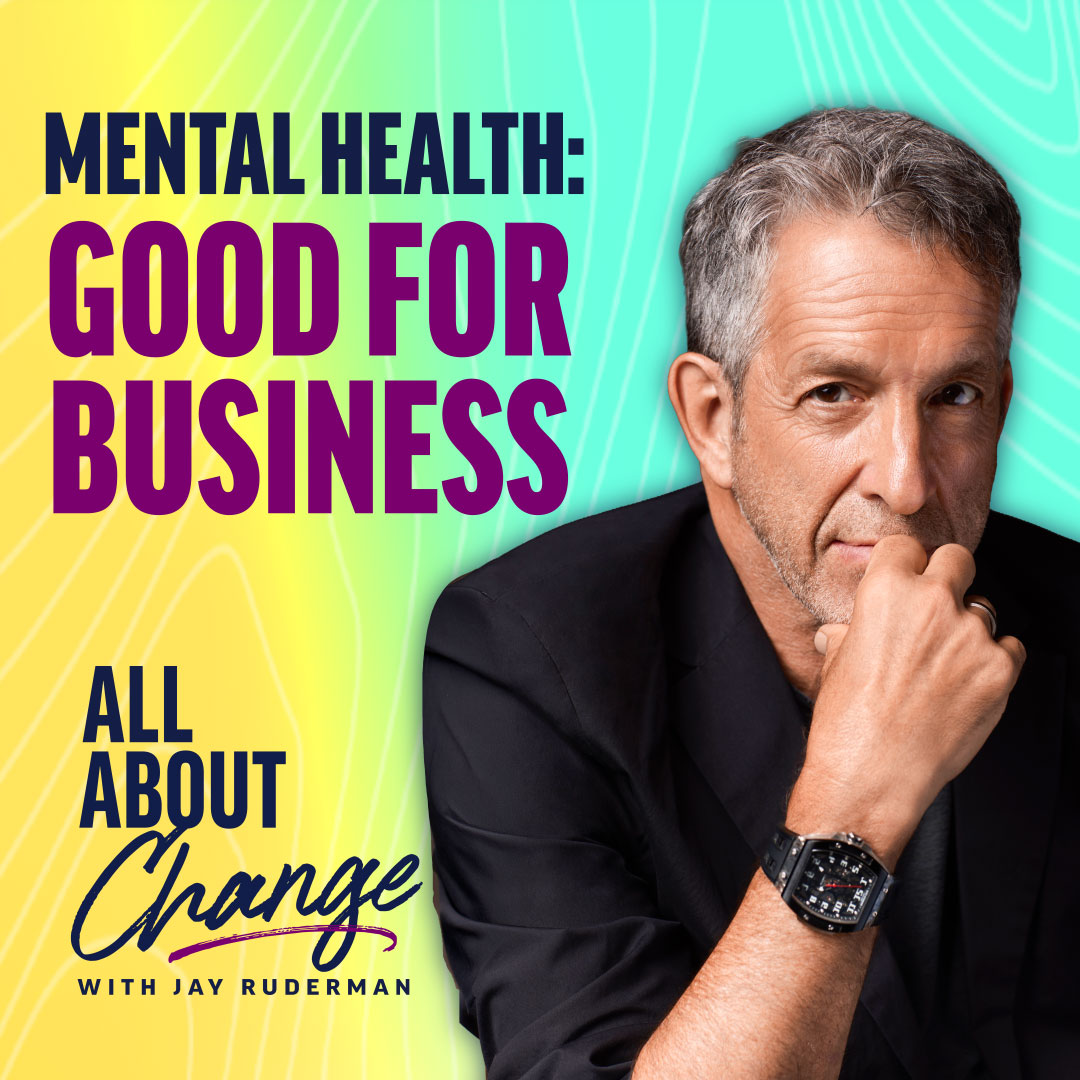
Kenneth Cole, has been a fashion icon for decades, innovating a unique and lasting style for which he is known. But he comes to All About Change to talk about another of his great passions: mental health awareness. Kenneth won the 2025 Morton. E Ruderman Award in Inclusion, an award my foundation presents to an individual who has made an extraordinary contribution to the inclusion of people with disabilities.
AboutWe discuss the Mental Health Coalition’s origin story, the state of mental health in America, how to work in mental health when you are not a doctor or mental health expert and much more.
The award recognized Kenneth’s transformative leadership in confronting mental health stigma and building a national movement for inclusion through storytelling, awareness, and action as the founder of the Mental Health Coalition.
Jay Ruderman:
Welcome to All About Change. Hey, All About Change listeners, it’s Jay here, and I wanted to tell you my book, Find Your Fight is now available in 800 Walmart stores.
In the book, I talk about my biggest successes and those of others and also failures as an activist, and my personal philosophy on how to make a difference. It’s the perfect gift for friends and family who care about making a positive change in our society.
Today, I have a special interview for you that’s been a long time in the making. My guest, Kenneth Cole, has been a fashion icon for decades, innovating a unique and lasting style for which he is known. But he’s joining me today to talk about another of his great passions, mental health awareness.
Kenneth won the 2025 Morton E. Ruderman Award in Inclusion, an award my foundation presents to an individual who’s made an extraordinary contribution to the inclusion of people with disabilities.
The award recognized Kenneth’s transformative leadership in confronting mental health stigma and building a national movement for inclusion through storytelling, awareness, and action as the founder of the Mental Health Coalition.
Now, I’m lucky to be sitting in Kenneth’s showroom and talk with him about some of the crucial work he and his team at the Mental Health Coalition are up to. Kenneth Cole, welcome to All About Change.
Kenneth Cole:
Thank you, Jay.
Jay Ruderman:
It’s my pleasure having you, and I’m really looking forward to our discussion about mental health. For the guests listening, we’re recording this interview in December, but you’re hearing it in May, which is Mental Health Awareness Month. Kenneth, how do you think about Mental Health Awareness Month as part of the effort to de-stigmatize mental health struggles and the process of them seeking and receiving mental health support?
Kenneth Cole:
So those are a few different questions in one. So first of all, what do I think of Mental Health Awareness Month? As a concept I like it a lot. I think it’s a social media event, but it’s a mechanism to aggregate thoughts to large audiences because the whole process on social media and the hashtags and the conversations that ensue bring together large amounts of points of view and perspectives, and you have a chance to connect meaningfully at that singular moment in time. And I always encourage people to participate if they can.
Jay Ruderman:
It’s akin to when celebrities come out and they talk about their own mental health struggles. We’ve, as a foundation, have awarded Kevin Love, Selena Gomez and Michael Phelps. And when they speak out about their own mental health issues, I think it gets a lot of people to say, one, it’s okay to talk about it, and two, maybe I should look into my own mental health.
Kenneth Cole:
The idea of normalizing the conversation around mental health is crucial. Ultimately, that is the single and most important way to address the pervasive and destructive stigma that is making it so hard for people to address their struggles. We say at the Mental Health Coalition, they say one in four will have a mental health condition in their lifetime. We say it’s four out of four because if it isn’t you, it’s somebody you love, somebody in your family, in the community, the workplace, but everybody’s going to live with it and going to confront it in a profound way.
The problem is not that in and of itself. It’s more so that two out of three of those people do so in the proverbial shadows because of the pervasive stigma. They’re reluctant to want to talk about it and they’re reluctant… They feel they’re likely to be judged or to be diminished socially and because of the choices that they’ll use to describe their struggles and the circumstances there.
And there isn’t really today a safe narrative that people can default to. And that’s what we’re trying to work on at the coalition.
Jay Ruderman:
But you can remember back to a time when social issues were hidden, especially by celebrities. I mean, I’m thinking about the example of Rock Hudson in AIDS, and until the end, did not want to come out and speak about it because he thought it would affect his status as someone in the movie industry. But you’ve always been out in front speaking out and you own a business and you have shareholders. So as a longtime activist, how as a business leader, you were able to also become an activist and how did you balance that between running a business and being out there and speaking out about social issues?
Kenneth Cole:
It was a little easier for me than it is for other people because HIV, AIDS, clearly there was an at-risk group that were severely stigmatized and they were gay men, they were intravenous drug users, and to a degree they were Haitians. I mean, that’s where the largest population groups in the earlier stages of the most likely to be… Likely infected or infectors or infected, that’s where it was emanating.
And I wasn’t in one of those at-risk groups. So it was a little easier for me, I think, I wasn’t as concerned about being stigmatized. And maybe it was also for that reason, there weren’t many people that were willing to do what I wasn’t concerned about doing. And it was on everybody’s minds, but nobody’s lips in those days because people were petrified that they were going to be diminished as a result. To your point right now, it wasn’t just in the early days.
Even to this day, there was countless people in parts of Africa and other parts of the world where they still would rather live with AIDS than get diagnosed and get treated, than be open about their status and avail themselves of all the therapies and treatments that are available. They would rather be quiet and live with the consequences, which is what’s so frightening.
Jay Ruderman:
So stigma is a huge part of what we deal with.
Kenneth Cole:
Yeah. As I used to say then and believed, and it’s probably still today, more people are dying from the stigma of AIDS than from AIDS itself. And that’s certainly the case with mental health related issues.
Jay Ruderman:
A lot of your colleagues or competitors, they don’t do that. They talk about their products. They have nice pictures that are attracting people with models and so forth, celebrities, you’re an activist and why do you think you’re an activist and others don’t join you in that?
Kenneth Cole:
I made a decision early on in my career that fashion is a relative expression. What’s fashionable to you may not be to me. And what’s fashionable today may not be tomorrow. And heel heights and hem lengths change every 15 minutes. But if I can make our relationship more about what you stand for rather than what you stand in and not just of what you wear, what’s on your body, but what’s on your mind, then I can have such a… Then our relationship is likely to be so much more sustainable and meaningful over time. And frankly, it’s what’s on your mind that will eventually influence what’s on your body and what you stand for will eventually influence what you stand in.
So that’s just a decision I made early on. And I came to realize that everything felt so much more fulfilling and meaningful once we started doing that.
Jay Ruderman:
Because you’re speaking out about social issues and because you’re addressing things that people are dealing with, the people who have worked for you, do they feel like they’re not just involved in selling clothing and shoes, but they’re involved in a bigger cause?
Kenneth Cole:
I think they do. I mean, I’m sure there’s cases where they don’t, but I believe in my heart most do. And social impact isn’t something we do here. It’s part of, as I say, who we are, and it’s embedded in the business model. It doesn’t exist in a corner office, it exists in every office. And everybody here hopefully touches it in one way or another in their ordinary course, and that’s the goal.
And then we have in here in the business as well, we have a mental health 501C3 not for-profit, and we have a handful of people that work only for it, and they have very clear business goals and deliverables, and transparent, objective, and attainable goals.
And they have an ROI, return on investment needs, as does the business people. And I do think everybody kind of inherently supports each other, works together, but has their own clear goals and objectives.
And I think we’ve created something, I think, bigger than some of its parts by doing it the way we do it.
Jay Ruderman:
Can you talk about the Mental Health Coalition and why it was important to you to try to pull together all of these different organizations that are working on mental health to try to create a larger impact?
Kenneth Cole:
So initially, actually, my daughter was working here at the time. She was working with the HR and she wanted to institute a program, a stigma-free workplace. It was a program that was created and administered by NAMI, National Institute for Mental Illness, the largest mental service program in this country to my knowledge. And I said, fine, we did it and everybody felt good about it. And I had a conversation with the people at NAMI, and they said, “Well, why don’t you carry the torch and do something bigger with this like you did with HIV and help de-stigmatize mental illness?” And upon reflection and conversation, we determined that this is so much bigger than NAMI and it’s so much bigger than us.
And it’s almost culture changing because it requires, if you’re going to address this debilitating stigma, it needs to be such a bigger collaboration and coordination and cooperation unlike anything I think that we’ve seen.
And I said to them, “If we’re going to do this, it needs to be bigger and this tent needs to be wide open and we need to bring in other people because…” And they said, “Bring in anyone you want.” That was basically the feedback and we’re on board, we’ll support it, spoke to the board, they’re on board, loved the idea.
So we started doing that. We reached out to about, at the end, 50 different organizations, all representing disproportionately impacted communities and asked them if they’d want to be part of this coalition. And they basically all said, yes. So the mental health coalition was formed. And with the goal ultimately of circling the wagons and addressing first and foremost, stigma, the debilitating stigma and anything else that nobody else could do individually that felt that maybe we could do collectively. I use the adage often that, alone you can go fast, together you can go far.
And there’s so much strength in numbers and viability and capacity building that you can’t create otherwise. So everybody said they’re in and I spoke to people at Pentagram and they donated generously a lot of the creative branding stuff and then we had a lot here and branding is very much… Messaging is what I’ve always done in my career, but it became apparent very quickly that it isn’t what was appropriate necessarily here for the mental health effort because everybody was doing their own and my goal was to amplify everybody else’s work, not to compete with it. So we’ve created a platform that does that.
Speaker 3:
We all feel like a square peg in a round hole sometimes. One in four of us will have a diagnosable mental health condition at some point in our lives. Four in four of us aren’t okay all the time. The Mental Health Coalition exists to de-stigmatize mental health so people can get the care and support they need.
Spearheaded by fashion designer and social justice advocate, Kenneth Cole, we are the world’s most influential alliance of mental health providers. We work with nonprofits, corporations, and everyday people to change the conversation through campaigns that meet people where they are in bite-sized info that’s easy to apply. Offer fresh resources developed by experts for anyone and everyone to access and understand. Build community, to scale awareness and support online and offline. MHC’s approach is working. Since 2019, MHC’s programs have reached an estimated one billion people. So while there is no normal, there is care, there is support, and there is a role for all of us to play. Join us.
Jay Ruderman:
In my book, Find Your Fight, I talk a lot about allyship, and I agree with you. When you can have like-minded organizations or people who are trying to work on the same thing, it makes sense to bring them together, unless you can’t trust them. But let’s say you can trust people. Organizations can be very territorial. Did you deal with that at all where organizations were saying, “Well, listen, we do this and I don’t want to work with them because…”
Kenneth Cole:
Everybody is territorial. By nature, they need to be. They need to justify their existence and everybody is proprietary. Everybody has to serve the hand that feeds them. And if it’s through a funder or if it’s through some sort of an enabler, and as long as you understand that and you can figure out how to align interests, then you can overcome it. And branding was one of the first things that became clear. And fundraising was a, everybody kind of is going to the same place.
So with the biggest of hearts and best of intentions, everybody’s often tripping all over each other. So how do you create that efficiency? And one of the ways is, first of all, is put them all around the same table. Most of these people had never even spoken to each other, but yet they’re competing with each other with the same goals and objectives.
And I think a lot of that just democratizes itself. I find the opportunities, if there’s redundancy, you become clear on that too. Nobody wants to put more resources behind efforts that are already being addressed. And as long as you also just create that awareness and that access to that knowledge, then people will find their opportunities to have the impact they uniquely can make.
Jay Ruderman:
But does it take someone like you, an outsider who has had success in advocacy to be able to… And has some celebrity to take these organizations together and to say, “I want to do this. It’s important.”
Kenneth Cole:
I think it’s easier for me because I make very clear, I’m not a doctor, I’m not a mental health expert, I’m not a public health expert, I’m not a psychiatrist. I am the least qualified person around almost every table I sit when we’re talking about MHC, Mental Health Coalition, and I make that very clear.
But what I am good at is convening people who are qualified, and that’s what that conference was that we had yesterday. It was bringing experts to the table, empowering them, giving them a pedestal. And I’m good at… I’m a good convener and enabler in that regard. And I make very clear, I’m not here to compete with anybody. I’m here to help you be the best version of yourself.
Jay Ruderman:
One idea in the Jewish tradition is that if you do a mitzvah, if you do a good deed, that it will bring another mitzvah. And the story of the Mental Health Coalition’s founding, like we talked about, you wanted to create a healthy workspace. And as part of that process, you learned about prevalence of mental health issues in the country, in the workspace. Can you talk about some of the positive outcomes and good deeds that have come as a result of the mental health coalition coming together?
Kenneth Cole:
We’re all about transparent, quantitative outcomes, and everything we do is with clear goals and deliverables. And otherwise, we wonder, is this the best use of… Is there a reason for us to even exist in this space?
So the first initiative that we undertook, or one of the earliest ones was actually spearheaded by my daughter, Katie. And it was, “How are you really?” Which is arguably the most asked question everywhere in the world in every language and the one most rarely ever answered, and howareyoureally.org, and we set that up and challenged people to answer that question and allow others to engage in conversation.
And I think we had 300 million people engaged with that content the first weekend. So the ability to reach a lot of people, trigger, initiate conversation that might not happen otherwise, positive conversation, encourage people, show people how to be, myself included, how to be there for each other, how to show up for each other, how to be empathetic, how to be vulnerable.
Vulnerability is a hard thing, especially for a guy and we’re bred not to be vulnerable, and men of color more than Caucasian, and Asian men even more than that. It’s just culturally, it’s just not something that’s encouraged and promoted. So how do you be that? And it’s okay to be that. And we’ve done that. We’ve brought together these one-to-ones. We had this massive conversations with Instagram, and now we’ve launched this tech platform that I think is going to change people’s lives everywhere.
Jay Ruderman:
So yesterday, you had a convening of the Mental Health Coalition, and Jay Glazer got up and spoke, and he has a history in the NFL and professional wrestling, and he talked about getting hurt, and that when you’re hurt, you don’t show it. You can break an… He gave an example of breaking an arm and you don’t show your opponent that you broke your arm. But then he also talked about how he was in a really dark place, and he came to the point where he was able to speak about depression, anxiety, being bipolar.
I thought that was really moving. I thought that was moving for someone to speak about their vulnerability and use it as a power. That goes to your point of the fact that sometimes men don’t want to show that they’re vulnerable, but as part of what you’re trying to get at with the coalition is we have to be more open and honest and not worry about what the consequences are going to be.
Kenneth Cole:
Well, hopefully there are no consequences. I mean, hopefully it enables you to address your consequences in a positive way because if you’re not open about them, you can’t address them and they’re going to fester and they’re only going to arguably get worse. And our goal is to normalize it, to formalize it, to institutionalize it, and to be okay to talk about your struggles. I mean, if you have a broken foot, you wear a cast and you tell the world, and it’s okay. So if I have a broken heart, I have a broken soul, I need to be able to share that.
And what about it is encumbering me and making it hard for me to get out of bed in the morning? And I think that needs to be an open discussion. And if you’re not well emotionally, you’re not well. If your heart isn’t working, your mind isn’t working, your body isn’t working, you’re not working, you’re not whole.
Jay Ruderman:
Kenneth, I’ve heard you talk about the impact that mental health and not addressing mental health has on the business community and the amount of money that’s lost as a result of that. Can you elaborate on that a little bit?
Kenneth Cole:
Yeah. So look, I try to make this an easier conversation because the compassionate case for mental health breaks down almost consistently, I have found. And you try to have that conversation with people and it doesn’t go very far because we all have this empathy, so called empathy quotient I read years ago.
And it is exhausted before you get out of bed in the morning, if you check your social media and if you look at your algorithms, and there’s only so much empathy you can have for so many people, but the world is divided and the world is in pain. And you go to work and you walk past people who are homeless and people who are needy, and you’ve become hardened. It’s the only way you get through your days and only way you get to where you’re going. But the business case works almost consistently, oddly.
And because, A, nobody has money that they can throw at anything, but if you can make a rational case that any sort of allocation of resources is not in fact an expense, but it’s an investment that will pay itself back over time, that’s all of our jobs. And I run a big business, relatively large business, and I’ve been doing it for a lot of years, and I do think and understand the impact of resource allocation. And I do think that, and it has become very clear that, and I have learned that there is unequivocal evidence that an allocation of resources towards mental health initiatives realizes an improvement in retention, recruitment, morale, and ultimate productivity. And that’s my job, that’s every CEO’s job. And it’s an easy decision to make if you can put it contextually in that regard and not making it.
So you can say why it’s a good thing to do, but you can also say why it’s an awful thing not to make it because it’s such a huge drain on our economy.
$1.3 trillion is spent annually by corporate America, which by the way, more Americans get their healthcare from their employer than from Medicaid and Medicare put together. And it’s a drain on your balance sheet, it’s a drain on your income statement and your operating statement.
And not to reapportion it is, A it’s irresponsible and it’s ineffective and it’s inappropriate in your capacity as a CEO and even more so as a human being.
Jay Ruderman:
When I was coming in here this morning, I was reading a news story about a major corporation where the CEO came out and said, “All employees have to come back five days a week.” And I was sort of taken aback and I’m like, “That sounds like going backwards a little bit.” I can’t remember who, I don’t want to name the person because I can’t really remember it, but I think that that is sort of a thing of the past. I think the way I run my organization is, if you can get your work done, I don’t care where you are, I don’t care what you’re doing, I can tell if you’re producing or if you’re not producing, but this whole thing of like, no, everyone has to come back. We have to go back to what we had pre-COVID seems a little outdated.
Kenneth Cole:
Yeah. Look, I think some industries it’s more important than others and in certain areas and responsibilities within certain businesses is more… I mean, if you’re involved with product, it’s hard to do that remotely. But I think the world will never be the way it was pre-COVID. And I think people will work remote and they’ll find jobs where they can be remote because they’re going to look to balance their personal and professional lives uniquely and they’ll make those decisions uniquely.
But I do think there’s a hybrid formula that people will settle on and companies will settle on and individuals will settle on it, and they’ll find something that works for them.
Jay Ruderman:
Kenneth, I want to end by saying, we talked about this a little bit, you’re an incredibly ambitious person and you’re really trying to make a change in this world. What are your hopes for the mental health coalition’s next steps?
Kenneth Cole:
I think we can be a bridge and create something greater, as I often say than the sum of its parts, because there’s so much capacity out there for good and there’s so many people who are well-intended and if we somehow create a mechanism to leverage all of that, and now with AI, you have the capacity to do that much exponentially more than we could have ever imagined before.
I think you can connect with people everywhere and all the time, and you can do it meaningfully if you’re programmed to do so. I think healthcare has changed profoundly because of AI and the ability diagnostically, it’s thousands percent more capable. Healthcare and access to psychological support is 24/7 now, and it’s everywhere. It didn’t used to be. But it can also be, if not used in a good way, it can also be destructive. But I do think everybody’s intentions, way more people’s intentions are to do this thing the right way.
And I do think, and I do believe that we can help encourage that and support that.
Jay Ruderman:
So Kenneth, thank you so much for being my guest on All About Change.
Kenneth Cole:
Thank you, Jay. Congratulations for your book.
Jay Ruderman:
Thank you.
Kenneth Cole:
Congratulations on what you guys are doing and-
Jay Ruderman:
Thank you.
Kenneth Cole:
And encouraging and promoting, and happy to be a part of it.
Jay Ruderman:
And I just want to say that you are one of my heroes because not only have you built a successful company, but you’ve become an outstanding activist who really knew how to use marketing to get the message out there. And you’ve changed our country and our world in terms of reducing stigma on AIDS and now focusing on mental health, which is the biggest issue I think people are facing right now. So it’s my distinct honor to have spent some time with you, and I wish that you will go from strength to strength. Thank you so much.
Kenneth Cole:
Thank you very much, Jay, to you and your family. And thank you for what you guys do for so many.
Jay Ruderman:
Thank you for being part of the All About Change community. We aim to spark ideas for personal activism, helping you find your pathway to action beyond awareness. So thank you for investing your time with us, learning and thinking about how just one person can make the choice to build a community and improve our world. I believe in the empower of informed people like you to drive real change, and I know that what we explore today will be a tool for you in that effort.
All right, I’ll see you in two weeks for our next conversation, but just one small ask, please hit subscribe and leave us a comment below. It lets us know that you value this content and it supports our mission to widely share these perspectives. If you’re looking for more inspiration, check out this next video. I chose it for you and I know you’re going to enjoy it.
I’m Jay Ruderman. Let’s continue working towards meaningful change together.
Today’s episode was produced by Tani Levitt and Mijon Zulu. To check out more episodes or to learn more about the show, you can visit our website Allaboutchangepodcast.com. If you like our show, spread the word, tell a friend or family member, or leave us a review on your favorite podcasting app. We really appreciate it. All About Change is produced by the Ruderman Family Foundation.