

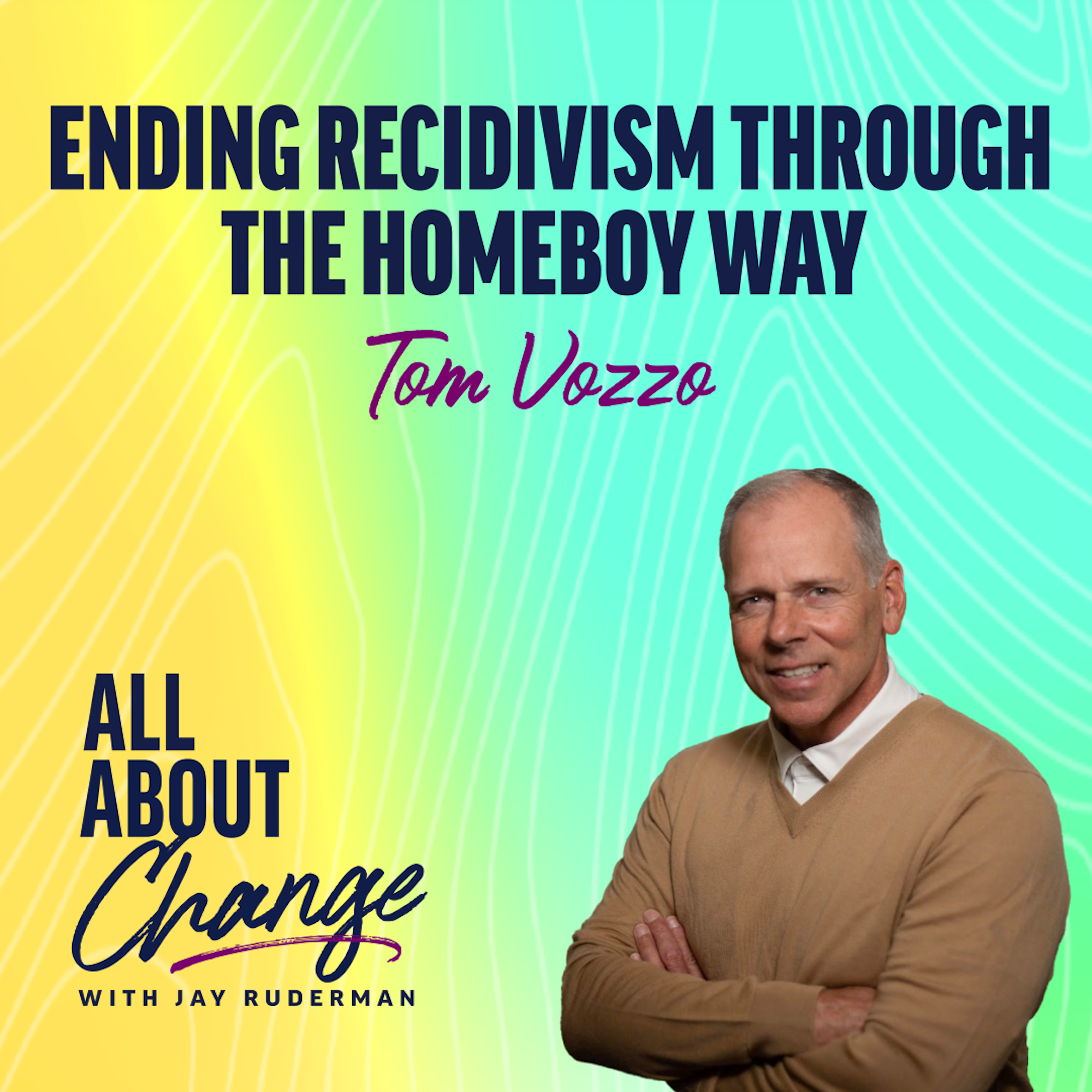
Tom Vozzo came to Homeboy Industries in a moment when they needed his skills. Around 2012, the organization was facing a financial crunch, and Tom stepped up from Homeboy volunteer to CEO steering the company to financial stability. In doing so, they make a bold and critical statement: No life is disposable, no person is beneath society, no person cannot be better, and no person will not benefit from helping another person reach the potential of who they can be.
AboutWorking at Homeboy changed Tom as well. Writing in his book, ‘The Homeboy Way,’ Tom said that after years of working with the poor, forgotten, and demonized people of our society, he came to learn that he didn’t really know as much about life as he thought.
Tom and the rest of the Homeboy team continue to support formerly gang-involved and previously incarcerated people, helping them redirect their lives and become contributing members of our community.
Jay Ruderman:
Welcome to All About Change. Hey, All About Change listeners. It’s Jay here, and I wanted to tell you my book, Find Your Fight, is now available in 800 Walmart stores. In the book, I talk about my biggest successes, and those of others, and also failures as an activist, and my personal philosophy on how to make a difference. It’s the perfect gift for friends, and family who care about making a positive change in our society. Tom Vozzo came to Homeboy Industries in a moment when they needed his skills. Homeboy Industries provides hope, training, and support to formerly gang involved, and previously incarcerated people, allowing them to redirect their lives, and become contributing members to our community. As an organization, they strive for five key outcomes, reduce recidivism, reduce substance abuse, improve social connectedness, improve housing safety, and stability, and reunify families. But around 2012, the organization was facing a financial crunch.
Tom joined Homeboy Industries as CEO steering the company to financial stability, but working at Homeboy changed Tom as well. In writing his book, The Homeboy Way, Tom said that after years of working with the poor, forgotten, and demonized people of our society, he came to learn that he really didn’t know as much about life as he thought. Thank God the gang crisis is not as prominent as it was in the late ’80s, and ’90s when Homeboy Industries was first founded, but Tom, and the rest of the Homeboy team continue to support formerly gang involved, and previously incarcerated people, helping them redirect their lives, and become contributing members of our community. In doing so, they make a bold, and critical statement. No life is disposable. No person is beneath society. No person cannot be better, and no person will not benefit from helping another person reach the potential of who they can be. Tom recently retired as CEO, transitioning to a senior advisor position. He’s still heavily involved with Homeboy Industries, and now hosts a podcast called The Homeboy Way, where he shares stories of growth, and healing. Tom Vozzo, welcome to All About Change.
Tom Vozzo:
Thank you, Jay. Appreciate you having me.
Jay Ruderman:
I am really looking forward to this discussion. I learned a lot about you, and about Homeboy Industries, and it’s an important conversation, so thank you.
Tom Vozzo:
You’re welcome.
Jay Ruderman:
I’ve already given an introduction about the Homeboy way in the intro, but can you briefly tell listeners about the process, and why has it been such a success, and the key role that healing plays in the Homeboy way?
Tom Vozzo:
Homeboy Industries, we’re based here in Los Angeles, and we’re a nonprofit organization. And in short, we help gang members leave gang life behind, and not recidivate back into prison. Now, we work with over 10,000 people every year, 500 people part of our paid program, which we can talk more about in a minute. But essentially, when people come out of prison, and jail, they really don’t want to go back to that lifestyle. But most times they have no other option. I mean, they got to survive on the streets. They got to get enough money for food, and shelter. But when they walk through our doors at Homeboy Industries, we help them. We give them a tangible help. And now every one of our folks are victims of complex trauma.
They’re second, third generation gang members. They were told your life is about the only way to survive is join a gang. And that’s what they did. And they joined a gang was a false hope. They did something bad, go to prison, and they’re coming out, they want something different. And so really, because of their trauma, they perpetuated trauma, what we’re all about is helping people heal, stabilize their life situation, help them develop positive relationships for the first time, and healing’s a key ingredient to all of that.
Jay Ruderman:
I listened to a recording of your podcast that you did with Father Greg Boyle, and you guys talked about that. So, maybe you can talk a little bit about that, about how someone gets to the point where they’re like, “I don’t want that life anymore. I don’t want to hang out with these people. I want to make a change. I’m seeking healing in my life.” How does that come about? How does someone make that decision?
Tom Vozzo:
Yeah. No, I definitely understand your question. And what’s interesting is people don’t use those words as they’re walking through our doors looking to change life. They’re just tired of that lifestyle. They’re tired of being always hustling on the street for money. They know what they’re doing is illegal, but they don’t find another way around it. They’re tired of the family telling them they’re not going to amount to anything. And mostly they don’t want their children to be in that same situation as they were in. And so what Homeboy has been around for now 38 years, and what we represent is really hope that someone can walk through our doors, and change their life going forward. So, many people come into Homeboy, and say, “I just need help.” Now, they’re not really exactly sure. They can’t put words to the type of help they’re looking for, but they’re tired of that lifestyle.
They’re tired of what it does to them, and their family. And they don’t even know they use the words of they’re broken, or they’ve been traumatized. I mean, really, they come out of the prison system angry, and frustrated. All their life, they’ve been told they’re not going to amount to anything. The educational system has failed them. The criminal justice system is always pointing their finger at them. Society sort of demonizes them, and so they’re tired of being on that side of it. And as you walk through the door as a homeboy, and anybody listening, we definitely invite you all to come to Homeboy, and visit. You feel an energy. You see how people want to be their best selves when they’re at homeboy, because in a safe environment, there are over 200 different gangs in the county of Los Angeles, but we work with a gang member.
And so as I said, we have an 18-month program, but not many people go through from beginning to end in straight 18 months. People fall backwards. There’s a lot of challenges in their life. The poll of their gang, trying to bring them back into the fold there, whether it’s drugs, or alcohol, or situation with a parole officer. So, we give people multiple chances. One few rules we have is that you can’t be running with the gang, and that’s the banging hanger, or slanging, no selling drugs, no hanging around with your gang members, no doing gang activity. Because if you’re not willing to leave that gang behind, then you’re not really doing our program, you’re not working on yourself. But the draw is tough because it’s the only relationships they’ve had in their life. And so oftentimes, as we’re asking them not to hang around with the gang, that means we’re telling them, “Don’t hang around with your siblings.”
“Don’t hang around with your uncle.” And the people that you thought were there all your life we’re saying, “Stay away.” And so it’s the loyalty pull more so than anything else. And a lot of people think there’s violence involved, and threats that that’s not as much in place, but it’s the loyalty that they hadn’t developed at a young person’s age to the gang, that we’re trying to show there’s a better way. You don’t have to be loyal to that type of lifestyle.
Jay Ruderman:
I’m really fascinated by the way Homeboy Industries has shaped you personally. As you said, you had a whole career as a CEO at several different major organizations. And now that you’ve moved out of the position of CEO of Homeboy Industries, and you’re touring, and you’re lecturing on the value of Homeboy Industries, how did this become a defining mission for you?
Tom Vozzo:
That’s a good question. No, I mean, I’m probably going to give you a little bit of a long answer to this. I show up at Homeboy. Father Greg, I show up as a volunteer. A couple months in, the organization was going through some financial stresses. Father Greg asked me to come on board as CEO. I already retired. I thought I was just going to volunteer, and do that type of thing for the rest of my life. Didn’t want to work again, but the opportunity to be in Father Greg’s orbit was too good of an opportunity to pass up. But what I loved about Homeboy from those first days is the authenticity of our people, of how, again, how they view how God’s helping them on their path, that they’re realizing that God’s not judging them. And as Greg would say, “God is too busy loving us to be judging us.”
And I sat there, and thought, “Oh, my gosh, if someone who has been in prison for 25 years, if someone who’s been in solitary confinement can sort of sit there, and just feel God’s love, I’m thinking to myself, ‘Tom, what are you missing? Pay more attention.” And so that has pushed me onto my spiritual journey. While I see Father Greg often, we are best exchanges really when we write emails to each other. It’s like pen pals type of thing. And I remember being stressed. And one year I was so focused on raising money, and we were coming up short, and even everything in my life got colored by. I thought about my friends. “Hey, I know how much money they have. They should give us more money.” I started having a negative view of people who weren’t donating enough, which is an awful attitude to have.
But then I was doing some spiritual reading at the end of the year, and my faith, and I’ve learned from Father Greg on Ignatian spirituality, this concept, Call the King. But it’s really about the faith is about understanding, praying for God, but also putting those values to action, and to show up every day for someone who needs you. And so I’ve been chatting with Greg, and he talks about that’s where we look for joy, and see our efforts. That it’s not about me saving somebody, but it’s about me finding joy through others. And when he explained that to me, a switch happened in my brain that, oh, every day my job is to show up priority is to show up, and find joy through others, seek joy through others. And then all the other stuff, I eventually work on it, and get it done, but it’s that attitude change that made a big difference that really has then propelled me deeper into my spiritual path.
Jay Ruderman:
So, someone comes into Homeboy Industries, and they’re former gang member, they’ve been incarcerated, what are they ultimately receiving? What type of benefits do they get? And sometimes being in a gang, the money comes very quickly, and there’s a lot of money. And how do you work against that? Where do they see the benefit from moving away from that sort of easy life? Not easy life, I shouldn’t say that, the easy money.
Tom Vozzo:
Easy money. But it sounds cliche for me to give you this answer, but what they get is love, and they get a sense of family, get a sense of people that care about them. Early in my time at Homeboy, I’m the CEO now. I’m management by walking around, and I’m walking to the bakery one day, and I hear one of our guys, George, talking to the manager asking for the weekend off. And George was one of our best farmer’s market guys. And he was asking for the weekend off, which is a big deal in the farmer’s market world. And so the manager said yes. And then I went up to George, and more glibly say, “Hey, what are you doing?” I was just trying to create small talk. And George says to me, “I’m reporting in.” I said, “Reporting in? What’s that mean?” He said, “Well, I’m going to county jail this weekend.”
And he can see the expression on my face. And so he explains, well, he was reporting into county jail because he owed money. And at that time, you can go into jail, you can report into county jail for three days, and earn off what you owe. Now, as an aside, it is just nutty in our society that when people leave the prison system, they have thousands of dollars of debt, not just restitution costs, but court costs, parole officer costs. And then to think that once they got out of prison that first month, they’re going to be able to get a job that pays enough money for food shelter, and to pay off the debt. It’s just the nuttiest, nuttiest thing. But George owed money, and he wanted to do it the legal way. And I went on that night thinking about it, “Wow, how great.”
“It’s tough that he’s going to jail, but he chose not to borrow money from his homies because he didn’t want to be indebted with them. He chose not to go to a loan shark. He chose not to sell drugs on the street to get the money. He was going to report into county jail, and earn off half the money he owed, trying to do it the right way because he felt like that’s what we’re asking of him.” Thought about it all weekend. And then on Tuesday, I made a beeline in, I wanted to see how it went. And I go into the bakery, I see George, and I say, “George, how did go?” And I could see the stress on his face, stress still on his face. And what makes George’s story different is that he was with us about six months, came out of prison six months prior, and he got custody of his two kids, a 10-year-old, and eight-year-old.
It’s not often that the father gets custody of the kids. Now, he’s leaving gang life behind, so he has no family support to help with the kids. And what happened on that weekend, the person who was going to watch his kids couldn’t make it. And so he reported into the county jail, left his 10-year-old, and eight-year-old in their apartment, in his apartment by themselves for the three-day weekend. Now just think about that as a parent. Oh, my gosh, how stressful would that be? Now, the kids end up fine, so that part of the story worked out. But what that taught me was people want to do the right thing, want to earn honest day’s wage. It also taught me not to judge that our folks face enormous impossible circumstances. And so our instinct is sometimes judge, well, maybe you shouldn’t have sort of reported into jail.
And our other instinct is to try to problem solve. And really at that point, what George needed was just sort of support, and caring, and a hug, because he kind of knew the tough situation he’s in. So, it is an interesting dynamic about… It’s not about the mind. These folks just want to move their life forward in a positive, loving, caring way.
Jay Ruderman:
Tom, the Homeboy Network has expanded worldwide under your leadership. When you launched the Global Homeboy Network in 2014, you took local lessons from Homeboy’s decades of operating in LA, but how did you expand it across the world?
Tom Vozzo:
Our network is something that… A lot of things that Homeboy just kind of grew organically. It’s not something we planned, and there’s no strategic plan in place, or business development plan in place to grow the network. But over the years, even today, there’ll be over 8,000 visitors to Homeboy every year coming in, seeing what we’re about, taking a tour. We freely share our experiences, and our programs, and how we do our work. Many colleges, universities, high schools come visit us. And then along the way, other organizations who are starting up come the Homeboy, and say, “Hey, our city needs what you all do. Can you come to our city?” And we say, “No, no, we’re not going to go, but we’ll teach you. We’ll tell you, we’ll share it with you.” So, over the years it has developed. So, now there are over 1150 organizations that have modeled themselves after us, and those organizations are in 42 states, and seven countries.
And it really is about sharing best practices. We’re really clear early on that we don’t want to be in other cities with our own teams that to really do gang rehabilitation, and reentry, it’s got to be born from the local flavor there. And so find leaders there, and we’ll teach them how we do it.
Jay Ruderman:
How do you deal with stigma? Obviously, you’ve reduced the stigma within Homeboy Industries, but when you’re dealing with the outside world, and it hits you, or it hits the clients, or the employees, how is that dealt with? Because it’s obviously prevalent in our society that people, once they have served time in prison, once they’ve been involved in a gang, there’s a stigma that they face when they go out into the world.
Tom Vozzo:
Yeah. I want to give two answers to that question. Obviously, it’s one of our goals is to shine a light on the goodness of people, all people. There’s no such thing as bad people. Everybody’s got goodness in them. And while Father Greg goes out, and gives speeches, and I give speeches, and we invite people to visit, it’s really, again, it’s this philosophy of getting relationship with people on the margins. You can see that there’s a whole bunch of reasons why they’ve had this tough lifestyle. And if you can take away those hurdles, then they’re actually going to have a lifestyle that everybody else wants to have.
If I’m talking to a business community, I’ll sit there, and say, “Listen, we have a Homegirl Cafe. It’s a [inaudible 00:17:30] rated cafe. There’s only seven other restaurants in downtown Los Angeles where that’s high as a rating, and it’s fully run by gang members, and felons.” So, if your organization doesn’t want to hire felons, or gang members, well, you’re missing out on a workforce. Every one of our businesses is run by a former gang member, and felon. And so that’s way of showing it. The other part of the answer I want to give is that we’re realistic, and our team’s realistic. We’re not changing everybody’s mind. And over, and over again, our folks face the stigma, face the quiet rejections, whether they’re trying to rent an apartment, and they may get a Section Eight voucher, but they’re not allowed to rent the apartment, or whether they’re going to another county agency getting mental health services.
Somehow our folks are put at the end of the line. So, I don’t say our folks are used to it, and they’re okay by it, but they understand that’s kind of like the score, and they’re just going to keep putting their head down, and kind of marching forward, and we help them through that. But sometimes it’s heartbreaking, the stigma that’s out there that people still hold on. But we’re trying to get the message out that it’s a group that’s worth investing in. And we are living proof that if you just love somebody, trust them, and invest in them, they change their life around.
Jay Ruderman:
It sounds like because of what some of the people at Homeboy Industries have gone through in their lives, in some ways they’re better employees, because they’re not taking for granted what many of us who are getting a job may take for granted. They’re like, “Okay, well, this is another job, and I want what’s in it for me.” But they may be saying, “Listen, this is a second chance at life.” And maybe that makes sense.
Tom Vozzo:
And they become very loyal employees. They really do.
Jay Ruderman:
So, maybe that’s something that we miss out as a society, that we’re judging people, and we’re not realizing what we’re missing.
Tom Vozzo:
Yeah, amen to that. Absolutely true.
Jay Ruderman:
Earlier this year, I talked to Steve Preston of Goodwill on the podcast. We talked about Goodwill’s work of reintroducing formerly incarcerated people into the workforce. And I’d like to ask you a question that I presented to Steve as well. Can you make the case for why minimizing recidivism needs to be a bipartisan cause?
Tom Vozzo:
And we’re a living example of that. Because of Homeboy’s reputation, and the work we’ve done, we’ve had people on both sides of the aisle come visit us, and we sit down, and we talk to them. And I can kind of go on the stereotypical side. It’s the healing part, it’s the mental health crisis that’s out there. All our people are victims of mental health, and complex trauma, so how do you heal so they don’t recidivate? If you want to talk from the business community side investing in jobs, if people don’t have meaningful employment, they’re going to be running in the streets, and running with gangs to make money. And so without a doubt, it’s like any angle you take, it makes sense to invest in this community with healing, education, and jobs because we have shown they don’t recidivate. And so let me give you our statistics.
Now, we don’t like talking about numbers that much. It wouldn’t be what Father Greg would do, but I talked to enough foundations that I have to give out my numbers. But a number of years ago, a study was conducted about homeboy industries, and it showed independently funded study that two years later, someone who was part of Homeboy Industries only had a 30% recidivism rate. So, in other words, 70% did not go back into the jail system under new charges. And if you take the statewide average, that’s two, and a half times better. So, statewide average was the opposite. It was 70% recidivated back in. So, look what that’s costing society of all that reincarceration. And yet we have serious violent offenders, and we’re able to, just by sheer caring for them, and loving them, and trusting them, they change the life around. And that’s a story that resonates on both sides of the aisle.
Jay Ruderman:
You think that you’d have the state of California banging down your door saying, “How do we replicate this all across the state?”
Tom Vozzo:
Right. Now there, now you’ve teed me up this sort of rant for a little bit, but I think what I’ve seen though is elected officials, whatever, but there’s a big bureaucracy in state government, and there’s a … Look, the county of Los Angeles has a $50 billion budget, $50 billion budget, and it’s hard for us to get a million dollar grant to do what we’re doing because they got to keep the jails going, and the sheriff department going, and all that going. So, it’s a tougher story to talk through, and it’s… But what I’ve seen is community-based organization with private investment with a little bit of money, that’s a good confluence, and it works.
Jay Ruderman:
I want to get back to you for a second. And some of the folks who come onto my show, they talk about that their activism happens outside of the nine to five. But for you, for the past 15 years, your activism has been at work. Have you made a conscious effort to keep the activist spirit in you now that you’re no longer CEO of Homeboy Industries?
Tom Vozzo:
Oh, very much so. And I appreciate how you frame up that question because one of the ideas I want to communicate to people is helping out a nonprofit, whether that’s called activism, volunteering, donating money doesn’t have to happen on your off hours. I mean, you can adopt those same philosophies in your life all day long. So, if you’re waking up every day, and your mantra is to seek joy through others, well, you can do that no matter any workplace along the way. If you’re waking up in your life, and you’re doing what we ask people at Homeboy is to move ourselves to be on relationship with people in the margins of our society, and just be in a relationship with them. Don’t wag your finger, just be in a relationship. Well, that doesn’t have to happen only on off hours. There’s always marginal… Wherever you are, any situation, so someone who’s marginalized there, and you can kind of be in that relationship.
And so to me, it’s more of a life philosophy. And so now I’m always six plus months into my senior advisor role, but I still get to come down to Homeboy, and live that out. And so I don’t see it being different, no.
Jay Ruderman:
I want you to talk a little bit about your book, and why’d you write it, and how’s been the process of marketing, and getting it out there, getting the message out there?
Tom Vozzo:
Called the Homeboy Way. It’s been out for a couple years now. The context is, again, I’m this corporate CEO of 26 years for profit sector. I saw up a Homeboy, and I really just want to help. I want to see if my business skills can be used in a different way. And the way I approached Homeboy was, I already have a successful career. I don’t need to find success, or find my platform, or reputation at Homeboy. I’m just here to help. It was easy for me to be that servant leader in that sense. But every day, from early on, it’s like, boy, Homeboy approaches people in a way I didn’t learn in the corporate world. Homeboy approaches topics I never learned in my life in the corporate world, almost like a 180 degree difference. In the corporate world, you’re taught to… You have to set precedent.
If you do one thing for one person, you got to do for the other. Not at Homeboy. If you come to me today, if you come to the staff today, and you need money for electricity, or else they’re going to shut your power off, we’ll give you the money. And some ultimately come to us tomorrow with the same almost request, but we know more of their story. And so we’re going to say, “Nope, we’re not going to give you the money. We may loan you the money, or we may do something else for you.” And there’s not this worry about setting precedent. It’s more about helping the individual. So, anyway, so there’s lots of examples like that. And the more extreme example is one of the scourgers are still around in the world, and our Homeboy world is domestic violence, right? And it’s a terrible thing in that community.
And at Homeboy, we have the victim, and we have the abuser. In the corporate world, you would just drum that abuser out. You’re just not having them part of your organization. But we know that we’re not helping that guy, and woman sometimes, no one else is going to help them. They’re going to keep on abusing people. So, we lean in to help. Now, it’s those types of things that I think, “Wow, Homeboy has a different approach.” And so I always thought, “Oh, if I was to go back into the for profit world, what would I take with me from Homeboy to bring it back?” And so that’s why I started writing the book. And then along the way is I have a bunch of those lessons in there. And then along the way, I wanted to highlight the struggles of the poor in our society, that there are two Americas, the America of you, and I, and the America of the poor, not a great insight, but I was on the front lines with people who are poor, and see the struggles of it.
And I see that, look, poverty rate in America has been the same for the last 60 years, has same narrow band, 12 to 13%. And I take a step back at Homeboy. We take people out of the prison system who are poor, dirt poor, and we’re able to help them, and help really not just help them heal, but help lift them out of poverty, and get a job outside of Homeboy that moves them up the line. So, I try to sort of shine the light of how to help the working poor in America. And the third reason that I went into the book is my own spiritual path. And if a hard charging type A personality corporate executive can find his spiritual path, I think others can as well, and it’s made my life much more fulfilling. So, I try to tell those stories as well.
Jay Ruderman:
You touch on some things that really resonated with me. First of all, I was a former prosecutor many years ago, and I prosecuted domestic violence, and what you say is true. We focus on the victim, and helping the victim, and the defendant, or the person that’s charged often gets punished, and pushed out, and ostracized, and it doesn’t help society, and I don’t think we’ve yet figured out how to deal with that. So, I think that’s a really important point that you made. Also, poverty in America, we don’t seem to be solving that problem. It’s an underclass that is always there, and is from generation to generation continuing. And I think as Americans, we have to learn how to fix that problem.
Tom Vozzo:
Yeah. And me, I call it as a business guy, look, what’s the definition of poverty? Not earning enough money. So, let’s create more jobs. And again, my workforce is a great workforce. Let’s create more jobs that gives them a decent pay, and lift them out of poverty. And that’s how you lower poverty is getting people up the economic ladder.
Jay Ruderman:
Tom, thank you so much for being my guest in All About Change.
Tom Vozzo:
Jay, I appreciate you having me.
Jay Ruderman:
I learned so much, and I really appreciate everything that you’ve done, and what you’ve devoted your life to. So, thank you so much.
Tom Vozzo:
Well, thank you.
Jay Ruderman:
Thank you for being part of the All About Change community. We aim to spark ideas for personal activism, helping you find your pathway to action beyond awareness. So thank you for investing your time with us, learning and thinking about how just one person can make the choice to build a community and improve our world. I believe in the empower of informed people like you to drive real change, and I know that what we explored today will be a tool for you in that effort. All right, I’ll see you in two weeks for our next conversation, but just one small ask, please hit subscribe and leave us a comment below. It lets us know that you value this content and it supports our mission to widely share these perspectives. If you’re looking for more inspiration, check out this next video. I chose it for you and I know you’re going to enjoy it. I’m Jay Ruderman. Let’s continue working towards meaningful change together.
Today’s episode was produced by Tani Levitt and Mijon Zulu. To check out more episodes or to learn more about the show, you can visit our website Allaboutchangepodcast.com. If you like our show, spread the word, tell a friend or family member, or leave us a review on your favorite podcasting app. We really appreciate it. All About Change is produced by the Ruderman Family Foundation.